
Every year, the industrial world turns its eyes toward Germany for Hannover Messe, the world’s most significant trade fair for industrial technology. But 2026 feels different. We aren’t just looking at incremental improvements in hydraulic presses or faster conveyor belts. We are witnessing the pivot point where “Industry 4.0” stops being a marketing buzzword and starts being a survival requirement.
Hannover Messe 2026 has become the epicenter for the convergence of the physical and digital worlds. It is the proving ground for “Production-Scale AI”—the transition from pilot programs to full-throttle autonomous operations. For manufacturers, the stakes have never been higher; with global supply chains still fragile and labor shortages becoming a permanent fixture of the landscape, the ability to automate complex decision-making is the only path forward.
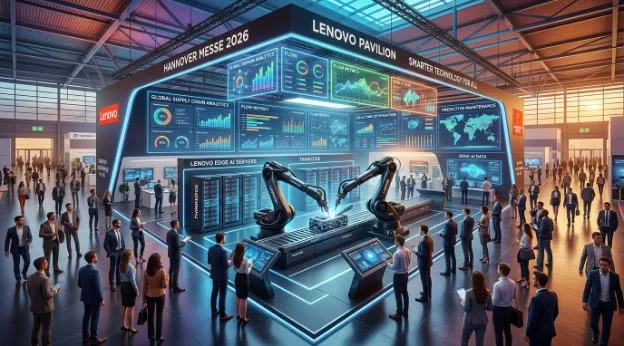
Lenovo’s Unprecedented Lead: 85% Faster Lead Times
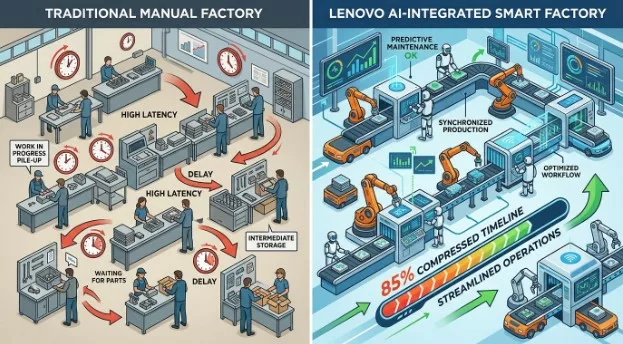
The headline coming out of the show is Lenovo’s announcement of new AI-driven manufacturing solutions capable of delivering up to 85% faster lead times. In a world where “time to market” is the difference between a record-breaking quarter and bankruptcy, an 85% reduction is not an improvement – it is a disruption.
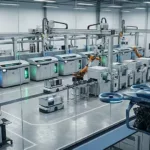
This isn’t just about making things faster; it’s about making them smarter. Lenovo is showcasing how their TruScale Infrastructure as a Service is being used to deploy “Agentic AI” across the factory floor. These systems don’t just flag errors; they predict them, reroute logistics in real-time, and optimize energy consumption without human intervention. This level of production-scale AI is what allows a manufacturer to pivot from one product line to another in hours rather than weeks.
The Only PC Maker Truly Focused on the Future
If you look at the landscape of traditional PC manufacturers, most are still trying to figure out how to sell more “AI PCs” to office workers. They are focused on the desktop. Lenovo, however, has realized that the real “desktop” of the future is the factory floor and the edge. While others are dabbling in consumer-grade AI, Lenovo is the only player in the space that has successfully integrated a vertical stack of hardware, software, and services specifically for robotics and industrial AI.
Their focus isn’t just on the silicon—though their partnerships with NVIDIA and AMD are industry-leading—it’s on the application. They are building the nervous system for the modern enterprise, moving far beyond the “box mover” reputation that still plagues much of the PC industry.
Lenovo vs. Dell: A Tale of Execution over Rhetoric
It is worth noting the irony of the current market. Over a decade ago, Michael Dell was vocal about the critical nature of the software-defined data center and the importance of integrated solutions. Dell pointed out the North Star for these segments long before many others. However, pointing at the mountain and climbing it are two different things.
While Dell has remained focused on the traditional enterprise and cloud infrastructure, they’ve largely missed the boat on the specialized, high-stakes world of industrial robotics. Lenovo has effectively “out-Delled” Dell by executing on a vision of integrated AI and robotics that Dell pioneered in theory but failed to dominate in practice. Lenovo’s agility and willingness to invest in its own manufacturing IP have allowed it to leapfrog the competition, delivering hardware like the ThinkEdge series that is specifically hardened for the environments where Dell’s more traditional servers might struggle.
The Advantage of Being Your Own Best Customer
The secret to Lenovo’s dominance isn’t just engineering—it’s experience. Unlike many of its peers who outsource production to third-party ODMs (Original Design Manufacturers), Lenovo owns a significant portion of its global manufacturing footprint. Over the last decade, they have used their own plants as “Lighthouse” factories to test AI and robotics.
They have lived through the pain points of AI integration. They have dealt with the data silos, the latency issues in robotics, and the complexities of human-machine collaboration. By the time they bring a solution to Hannover Messe, it has already been battle-tested in their own facilities. This “Eat Your Own Dog Food” approach gives them a massive experience advantage. When a Lenovo consultant speaks to a manufacturing CEO, they aren’t talking about theoretical gains; they are talking about what they have already achieved in their own plants. This makes Lenovo the “go-to” vendor because they aren’t just selling tools; they are selling a proven blueprint.
Positioned for the New Age
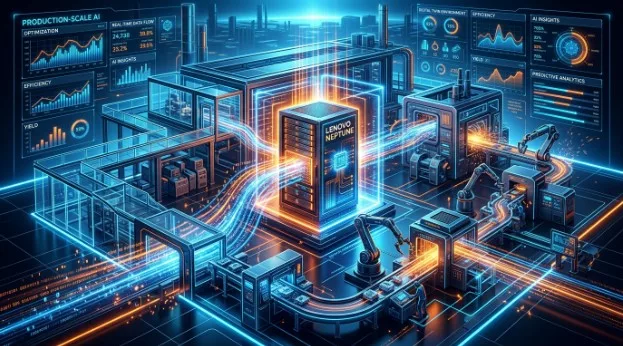
Lenovo’s overall performance reflects this strategic clarity. As we move into an era where “Digital Twins” and “Human Digital Twins” become standard for industrial planning, Lenovo’s end-to-end portfolio—from the Motorola devices in a worker’s pocket to the ThinkStation workstations and the massive Neptune liquid-cooled servers in the back end—creates a seamless ecosystem.
They are uniquely positioned to help companies bridge the gap between IT (Information Technology) and OT (Operational Technology). This is the “new age” of business—one where the intelligence of the network is indistinguishable from the productivity of the factory.
Wrapping Up
The shift we are seeing at Hannover Messe 2026 is a testament to the power of long-term strategic investment. Lenovo’s ability to deliver 85% faster lead times is the direct result of their decision to own their manufacturing and aggressively automate their own processes years ago.
While competitors like Dell have focused on the traditional enterprise, Lenovo has captured the future of the industrial edge. They have transitioned from a PC company to a global technology powerhouse that is literally building the machines that build the world. If you are a manufacturer looking to survive the next decade, the path clearly runs through the AI and robotics ecosystems Lenovo has spent the last ten years perfecting.