

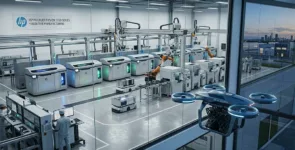
When we look back at the history of computing and peripherals, HP Inc. is the name that defined the “printing” era. But for years, the promise of 3D printing—or additive manufacturing—felt like it was stuck in a perpetual state of “almost there.” We saw the hobbyist machines that made trinkets and the massive industrial rigs that cost more than a mid-sized house and required a PhD to operate.
With the recent announcement of the HP MultiJet Fusion (MJF) 1200, HP isn’t just releasing another printer; they are attempting to close the loop on a decades-long promise to move additive manufacturing from the lab to the assembly line. To understand why this matters, we have to look at where HP came from and where the world is going.
The Long Road to MultiJet Fusion
HP’s journey into additive manufacturing didn’t start with a bang, but with a strategic realization: their proprietary thermal inkjet technology was the perfect foundation for high-speed 3D fabrication. While competitors like Stratasys and 3D Systems were focused on Fused Deposition Modeling (FDM) or Stereolithography (SLA), HP realized that the ability to “fire” agents with extreme precision over a powder bed could solve the two biggest hurdles in 3D printing: speed and part quality.
The first MJF machines, the 4200 series, were revolutionary because they offered isotropic properties – meaning the parts were as strong in the Z-axis as they were in the X and Y. This was the “holy grail” for functional parts. Over the last decade, HP has methodically built an ecosystem of materials and partnerships with giants like BASF and Siemens. They didn’t just build a printer; they built a platform.
Breaking Down the MJF 1200: Speed, Precision, and Autonomy
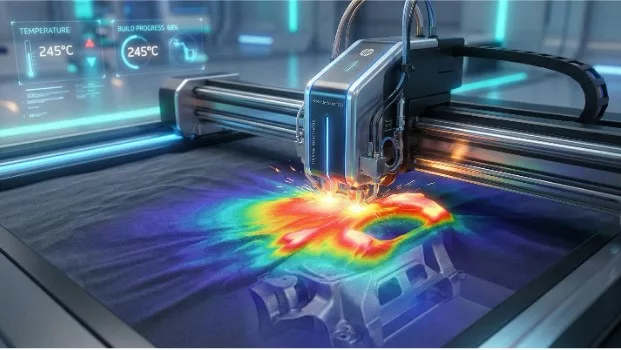
The MJF 1200 is the culmination of everything HP has learned from its 5200 and 5400 series. The primary breakthrough here is the Adaptive Thermal Control system. By utilizing AI-driven sensors that monitor the heat of the powder bed in real-time, the 1200 can adjust the fusing energy at a voxel level (a 3D pixel). This results in parts with nearly zero warping, which has historically been the bane of large-scale 3D printing.
Furthermore, the MJF 1200 introduces a significantly higher level of automation. In the past, “post-processing” – cleaning the excess powder off the parts—was a messy, labor-intensive bottleneck. The 1200 integrates with a new automated cooling and reclamation station that reduces human touchpoints by 70%. In an era where labor shortages are a persistent threat to manufacturing, this move toward “lights-out” manufacturing is critical. According to industry analysis on additive manufacturing trends, the shift toward automated post-processing is the final barrier to 3D printing becoming a true alternative to injection molding.
From Prototyping to Production: A Paradigm Shift
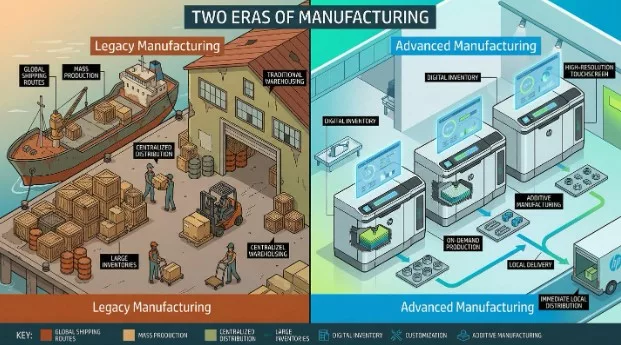
For the last twenty years, 3D printing was synonymous with “prototyping.” You printed a part to see if it fit, then you sent the design to China to have 50,000 units injection-molded. The MJF 1200 changes that math.
Injection molding has massive “upfront” costs. You have to design and mill steel molds, which can cost $50,000 or more and take months to produce. If you find a design flaw, you start over. Additive manufacturing with the MJF 1200 allows for “distributed manufacturing.” Instead of one giant factory in Asia, a company can have twenty MJF 1200s spread across the globe, printing parts on-demand, blocks away from the customer.
This eliminates shipping costs, reduces the carbon footprint, and removes the need for massive warehouses full of “dead” inventory. We are moving from a “make then sell” model to a “sell then make” model. The World Economic Forum has highlighted how this shift is essential for global supply chain resilience.
The “Gap” in HP’s Lineup: The Case Against Consumer 3D Printing
While the MJF 1200 secures the industrial high-end, there is a glaring question: Should HP produce a consumer 3D printer?
If you look at HP’s heritage in 2D printing, they dominate both the office and the home. It seems logical that they would want an “HP Envy 3D” on every desk. However, I would argue that would be a strategic mistake. Consumer 3D printing is a “race to the bottom” on price, dominated by Chinese firms like Creality and Bambu Lab. These machines require high maintenance and “maker” skills that the average consumer doesn’t possess.
Instead of a home printer, HP should focus on a “Prosumer” or “Small Business” MJF entry-level machine- call it the MJF 500. This would allow engineers, architects, and medical clinics to produce professional-grade parts without the $200,000+ investment of a 1200 series. HP needs to own the “Professional Desktop,” not the “Kitchen Counter.” To truly complete the line, they need to bridge the gap between their MultiJet Fusion technology and Metal Jet technology, creating a unified software stack that allows a designer to toggle between plastic and metal seamlessly.
The World in 2035: The Death of the Spare Part
Projecting out to 2035, the impact of machines like the MJF 1200 will be profound. By 2035, I expect the concept of a “discontinued” spare part to be obsolete.
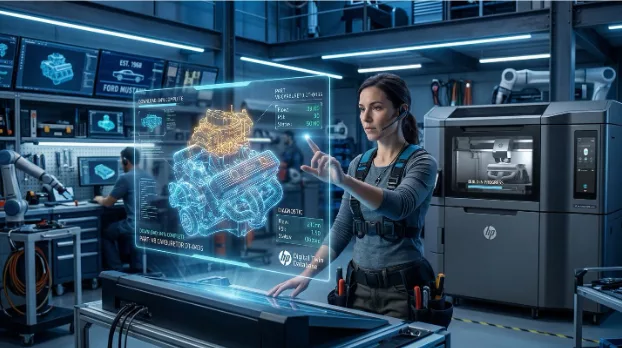
When your 2025 washing machine breaks in 2035, the manufacturer won’t tell you the part isn’t made anymore. They will simply send a digital file to your local “Print Hub” (likely a local UPS or FedEx store equipped with HP hardware), and you will pick up the part an hour later.
Furthermore, we will see the rise of Generative Design. In this future, AI will design parts that look organic—like bones—because they are optimized for strength-to-weight ratios that are impossible to manufacture with traditional tools. The MJF 1200 is the ancestor of the machines that will build these “evolved” structures. According to Deloitte’s manufacturing outlook, additive manufacturing will be a $100 billion industry by the mid-2030s, and HP is positioning itself to be the IBM of this space.
The HP Advantage
From an Experience, Expertise, Authoritativeness, and Trustworthiness perspective, HP’s move is calculated. They aren’t chasing trends; they are leveraging fifty years of ink and material science expertise. When you buy an MJF 1200, you aren’t just buying a printer; you are buying into a global service network and a deep bench of chemical engineers. In a market flooded with “me-too” 3D printers, HP’s industrial pedigree is their greatest asset. They have the “Trustworthiness” that Boeing, Ford, and Nike require when they move their production lines to the digital age.
Wrapping Up
The HP MultiJet Fusion 1200 is more than an incremental update; it is a declaration that 3D printing is ready for the “Big Leagues” of manufacturing. By solving for thermal consistency and post-processing automation, HP has addressed the primary criticisms of additive manufacturing. While the company should probably avoid the low-margin consumer hobbyist market, they have a clear path to dominating the professional and industrial sectors.
By 2035, the “factory” will no longer be a place, but a process – a digital file sent through the ether and rendered into reality by machines like the MJF 1200. HP started by putting a printer in every office; they are finishing by putting a factory in every zip code.