


Google’s I/O 2026 just lit a match under the traditional software stack. If the makers of Office, Photoshop, and legacy IDEs don’t pivot immediately, they are walking right into the same trap Nokia and BlackBerry fell into during the iPhone revolution.
At Google I/O 2026, the tech giant wasn’t just announcing new features—they were quietly organizing a funeral for the way we’ve worked for the last thirty years. With the launch of the Gemini 3.5 series, specifically Gemini 3.5 Flash and the terrifyingly capable Antigravity 2.0 platform, Google fired a direct broadside at the monolithic productivity suites that have dominated enterprise and creative markets.
We are no longer just talking about “AI assistants” living inside sidebars. We are talking about Agentic AI that runs continuously in the background, capable of operating systems from scratch and building full-stack applications while you sleep. And the immediate targets? Legacy giants like Microsoft Office, Google’s own legacy Docs, Adobe Creative Cloud, Apple Creator Studio, and a host of integrated development environments (IDEs).
Here is why these legacy product owners need to fight back immediately, and what they can learn from the ghosts of tech failures past.
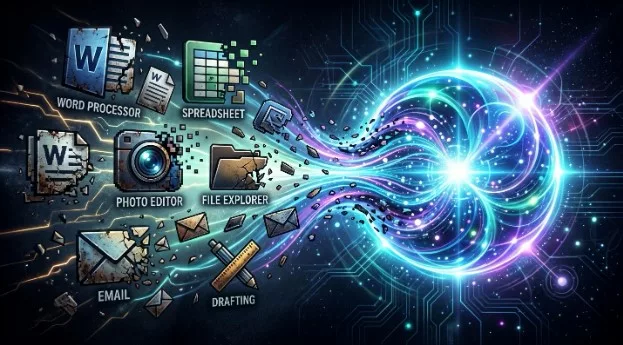
The Hit List: Who Gemini 3.5 is Coming For
The capabilities demonstrated with Gemini 3.5 Flash and Gemini Spark aren’t just iterative upgrades; they are category killers.
- Microsoft Office (Word, Excel, PowerPoint) and Google’s Legacy Workspace: The new Docs Live feature allows users to perform a “verbal brain dump”—speaking naturally about a topic—and Gemini structures it into a polished, formatted document. Gemini Spark, a 24/7 personal AI agent, can synthesize meeting notes across emails and chats and draft the resulting documents automatically. Why spend an hour wrestling with formatting in Word or PowerPoint when an agent can build a customized, highly accurate presentation based on a simple voice command and real-time data scraped by the new “Information Agents”?
- Adobe Creative Cloud and Apple Creator Studio: Google showcased Google Pics with aggressive, on-device AI editing, and Google Stitch, which allows users to command entirely new website designs into existence via voice. More devastatingly, Gemini Omni allows users to input any modality (text, audio, image) and output highly accurate, physics-aware video. The days of needing a multi-tool suite like Premiere Pro or Photoshop to execute basic or even intermediate creative visions are numbered when Omni can execute complex post-production workflows autonomously.
- Legacy IDEs (Visual Studio, Eclipse, etc.): The most shocking demonstration at I/O was Antigravity 2.0. This agent-first development platform spun up specialized subagents that generated a fully functioning operating system from scratch in roughly 12 hours. It can also “vibe code” full-stack Android apps natively. If you are selling an IDE that requires a developer to write boilerplate code manually, your product is now fundamentally obsolete.

Avoiding the BlackBerry Trap
The tech graveyard is full of companies that saw a paradigm shift and decided their existing market share would protect them.
When Apple launched the iPhone, Nokia, BlackBerry, and Microsoft (with Windows Mobile) scoffed. They believed their physical keyboards, established carrier relationships, and corporate email dominance made them invulnerable to a device lacking a physical keypad. They fundamentally misunderstood that the iPhone wasn’t just a phone; it was a pocket computer.
Similarly, in the 1990s, productivity giants like Lotus (1-2-3) and Novell (WordPerfect) dominated the market. They failed to realize that Microsoft Office’s integration—bundling applications into a single, cohesive, albeit initially clunky suite—was the future. They clung to their standalone dominance and were obliterated.
Today, Microsoft, Adobe, and Apple face the exact same threat from Google’s Agentic ecosystem.
If Microsoft simply bolts “Copilot” onto the side of an increasingly bloated Word or Excel interface, they will fail. If Adobe continues to charge premium subscriptions for complex interfaces while Google Omni allows a user to say, “Make this video look like a 1980s VHS tape and adjust the lighting,” Adobe will bleed out from the bottom up.
The mistake legacy software makers make is trying to optimize the old way of doing things rather than inventing the new way. The new way is autonomous, continuous, and agent – driven.
Will They Pivot in Time?
The likelihood of these massive companies pivoting successfully is mixed, but the stakes have never been higher.
Microsoft is perhaps the best-positioned to fight back. They have a massive enterprise moat, a tight partnership with OpenAI, and they understand platform dynamics. However, they need to aggressively intertwine OpenAI’s capabilities deeper into the OS layer—making Windows itself an agentic platform—rather than just adding AI features to legacy Office apps. They need to disrupt their own cash cows before Google’s Antigravity and Spark do it for them.
Adobe has a steeper hill to climb. Their entire business model is predicated on software complexity that requires human mastery. While they have introduced AI (like Firefly), they are still fundamentally selling tools to creators, whereas Google is moving toward selling outcomes.
Apple is the wild card. While Google is pushing heavily into cloud-based agents and cross-platform tools, Apple has the hardware advantage. Their counter-move must be hyper-private, on-device agentic AI that executes flawlessly within the Apple ecosystem, bypassing the need for Google’s cloud infrastructure entirely.

The Timing of the Collapse
So, when does the bottom fall out? Historically, enterprise software has a massive “stickiness” factor. It takes a long time for users to abandon a product they’ve used for decades, primarily due to muscle memory, legacy file formats, and corporate IT inertia.
However, things are moving exponentially faster this decade. Google highlighted that AI Mode queries have been doubling every other month, and Gemini active users have surged past 900 million. The transition won’t happen overnight, but it will happen in a surprisingly compressed timeframe. Expect to see the first major fractures in the market share of legacy IDEs and mid-tier design tools within the next 18 to 24 months, as companies realize they can save upwards of $1 billion a year by utilizing tools like Gemini 3.5 Flash and Antigravity instead of maintaining massive legacy codebases or outsourcing basic design tasks.
Wrapping Up: How Enterprises Can Survive the Shift
For enterprises and individual users, the arrival of Gemini 3.5 Flash and the era of agentic AI is thrilling but perilous. Moving too quickly to abandon legacy systems can cause operational chaos, but moving too slowly ensures obsolescence.
To take advantage of this advancement without moving prematurely, organizations must:
- Adopt an “Orchestration” Mindset: Stop training employees on how to use specific software features (like complex Excel macros or Photoshop layering) and start training them on how to define goals, write complex prompts, and manage AI agents. The future belongs to the orchestrator, not the operator.
- Sandbox the New Tech: Don’t rip out Microsoft Office tomorrow. Instead, create dedicated teams to pilot Gemini Spark and Antigravity 2.0 on specific, low-risk, high-friction workflows (like internal documentation or rapid prototyping).
- Demand Interoperability: As Google pushes the “Universal Cart” and cross-platform agents, demand that your legacy software vendors do the same. If an application cannot integrate cleanly with the new AI agent ecosystem, it needs to be flagged for replacement.
The war for the desktop is over; the war for the autonomous background has just begun. The software you use today is already legacy. The only question is how quickly you are willing to let it go.