

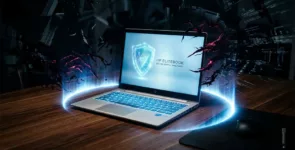
I probably should have waited until the end of October to write this. There is something inherently “spooky season” about discussing things that take control of your body—or your computer—against your will. But as I look at the current state of cybersecurity, the demons aren’t waiting for Halloween.
We are entering an era where malware isn’t just a nuisance; it’s becoming an AI-powered entity capable of mimicking human behavior and bypassing traditional defenses with terrifying ease. Fortunately, HP has been working on something of a “Digital Exorcist.” With the evolution of their Workplace Experience Platform (WXP), they are moving toward a reality where the “demons” in your hardware are identified and cast out before they can do any real damage.

A Night at the Movies and the Birth of Pure Terror
To understand why I’m so focused on “possession,” you have to understand my history with The Exorcist. When the movie first came out, the hype was unlike anything we see today. I took my stepsister to see it, and the line was so long it felt like it stretched into the next county. Tempers were high. I nearly got into a physical altercation with a guy who thought he could skip the queue – apparently, I was willing to fight for the right to be traumatized.
I won the fight (the guy walked away), but I lost the night. The movie scared me so profoundly that I didn’t even go back to my own apartment. I retreated to my parents’ house, seeking the safety of people. In the middle of the night, a cat in heat let out a blood-curdling yowl right outside my window. I sat up so fast and with such explosive adrenaline that my bedding literally ended up on the far wall. I was convinced the devil had come for me in suburban California.
That feeling—of something lurking, something unseen that can suddenly take control of your environment—is exactly what it feels like to realize your PC has been compromised.
The Modern Malware Possession
In the old days, a computer virus was like a cold; you felt a bit sluggish, maybe saw a pop-up, and you ran a scan. Today, malware is more like the demon Pazuzu. It enters silently, often through a simple phishing link or a compromised file, and then it begins “living” in your system. It watches you through your webcam, listens through your microphone, and waits for the perfect moment to exfiltrate your identity or lock down your company’s entire database for ransom.
The threat is becoming exponentially worse because of AI. We are seeing the rise of “Agentic AI” in the hands of bad actors. These aren’t just scripts; they are autonomous digital entities that can probe your defenses, learn from your responses, and pivot their attack strategy in real-time. If you think a cat yowl in the night is scary, wait until you realize an AI-driven Trojan has been impersonating you in emails to your CFO for three weeks.

HP Wolf Security: The Holy Water of Hardware
This is where HP’s unique approach to security becomes critical. Most companies try to solve security at the software level – which is like trying to keep a demon out by hanging a “No Trespassing” sign on the front door. HP, however, builds security into the very silicon of the machine.
HP Wolf Security provides a hardware-enforced foundation that acts as a containment field. Their “Sure Click” technology, for instance, uses micro-virtualization to trap malware in a tiny, isolated container. If a file is “possessed,” the demon can scream all it wants, but it can’t leave that digital room. When you close the tab, the demon—and the container—are simply blinked out of existence.
It is the closest thing we have to digital holy water. HP has realized that in a world of AI-driven threats, you cannot trust the operating system alone. You need a root-of-trust that begins before the OS even loads.
The WXP: A Digital Exorcist for the Hybrid Era
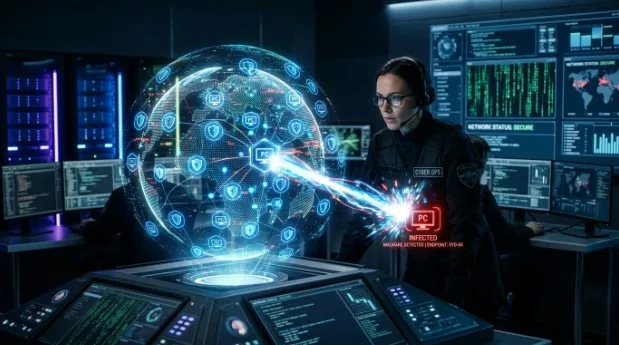
The recent updates to HP’s Workplace Experience Platform (WXP) take this a step further. By integrating AI-driven insights, the platform can monitor the “health” of a fleet of PCs across a global workforce. It looks for anomalies—those tiny, strange behaviors that suggest a system isn’t quite itself.
Think of WXP as the priest who walks into the room and immediately notices the temperature has dropped twenty degrees. It uses telemetry and AI to identify potential issues—whether they are hardware failures or security breaches—before the user even notices a problem. It provides IT managers with the tools to “exorcise” these issues remotely, ensuring the employee remains productive and the company remains secure.
I’ve often said that if my laptop monitor ever spontaneously spins 360 degrees and starts barfing pea soup, I’m not calling IT—I’m moving to Canada. But with WXP, HP is ensuring that your IT department can see the “levitation” starting and ground the device before the soup starts flying.
The Coming AI Storm
Over the next few years, the impact of AI on malware will be transformative. We will see polymorphic code that changes its signature every few seconds to evade detection. We will see deepfake voices that can bypass biometric voice authentication. The “Possession” of our digital lives will become the primary weapon of state actors and criminal syndicates alike.
In this environment, a standard PC is a liability. You need a device that is designed with the assumption that it will be attacked. HP’s strategy of combining hardware-level isolation with AI-driven monitoring creates a layered defense that is increasingly difficult for even the most sophisticated “digital demons” to penetrate. They aren’t just selling laptops; they are selling peace of mind in an increasingly haunted digital world.
Wrapping Up
The transition to AI-driven PCs and “Agentic AI” is the most significant shift in computing since the internet itself. However, with great power comes great—and often terrifying—risk. My experience with The Exorcist taught me that fear is often a result of feeling powerless against an unseen intruder.
HP’s Workplace Experience Platform and Wolf Security suite are designed to return that power to the user and the IT professional. By building security into the hardware and using AI to monitor for possession, HP has created a robust “Digital Exorcist” that can identify, contain, and eliminate threats before they become nightmares.
We live in a world where the cats are always yowling in the night; it’s nice to know your PC won’t be the thing that makes you jump out of your skin.