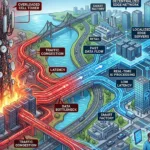

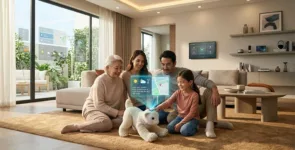
In the technology world, we often talk about “disruption” as if it’s a purely mechanical process—faster chips, better screens, more efficient code. But every once in a while, a company emerges that understands that for technology to truly integrate into our lives, it needs to move beyond the cold logic of a circuit board and tap into something more ephemeral: character. That is precisely what is happening with the launch of Familiar Machines and Magic, and it might just be the most important thing to happen to robotics since we convinced a vacuum cleaner to stop eating our shoelaces.
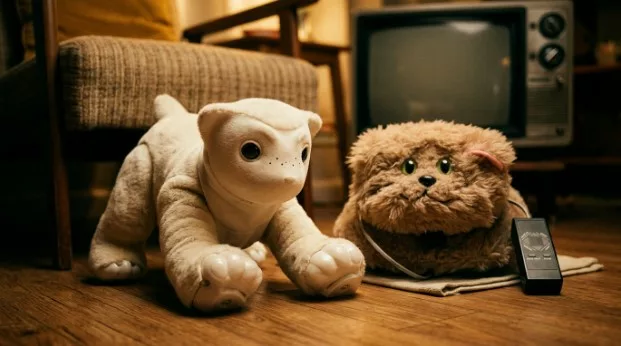
A Trip Down Memory Lane with Red-Eyed Hell-Cats
To appreciate where we are going, we have to look back at the glorious, slightly terrifying failures of the past. If you go back to the early 1980s, the legendary Nolan Bushnell—the man who gave us Atari and Chuck E. Cheese—founded a company called Androbot. His vision was a world filled with personal robots that would act as companions. The technology was, to put it mildly, optimistic for its time.
I actually owned one of their robotic cats. It was a marvel of beige plastic and clunky motors, but it had one feature that was accidentally brilliant: a pair of glowing red eyes. At the time, I was locked in a nightly psychological war with my actual, biological cat. He believed that my closed bedroom door was a personal insult and would pound on it until I surrendered.
I eventually decided to use the robotic cat as a sentry. I placed it in front of the door with those red eyes blazing into the dark hallway. My cat walked up, saw what appeared to be a mechanical demon from the feline underworld, and decided he was suddenly very busy elsewhere. It was a crude form of companionship—or at least, a crude form of security—but it proved that a physical machine could influence a living environment in ways a screen never could.
The Practical Ethics of Unbreakable Empathy
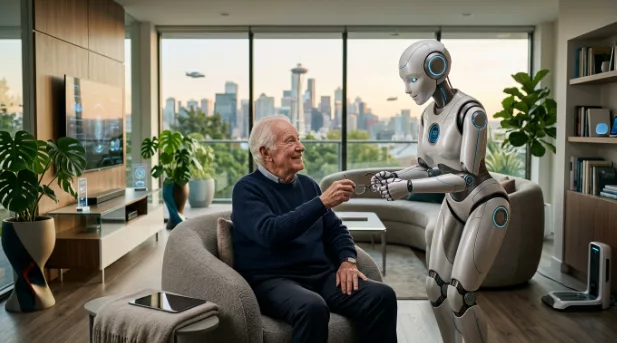
While scaring pets is fun, the real-world application for Familiar Machines is deeply humanitarian. We currently have a massive demographic shift: an aging population that is increasingly lonely and often restricted by limited mobility. Many of these individuals desperately want the companionship of a pet but can no longer manage the physical demands of walking a dog or the health risks associated with a litter box.
A physical AI pet doesn’t need a 6:00 AM walk in the snow, and it won’t trip its owner in the hallway—a leading cause of hip fractures in the elderly. It provides the tactile comfort of a living creature without the logistical nightmare.
Furthermore, we need to talk about children. We like to think of kids as “natural” animal lovers, but history suggests they are often more like tiny, chaotic scientists. I recall a former colleague who shared a horrifying story of her childhood curiosity: she decided to see what a hot poker would do to her family dog’s genitals. It’s a grisly reminder that real animals are vulnerable to the impulsive cruelty of children who haven’t yet developed empathy. An AI pet, however, is virtually indestructible and incapable of feeling pain. It serves as an “empathy trainer,” allowing children to learn how to care for a creature before they are trusted with a living, breathing one.
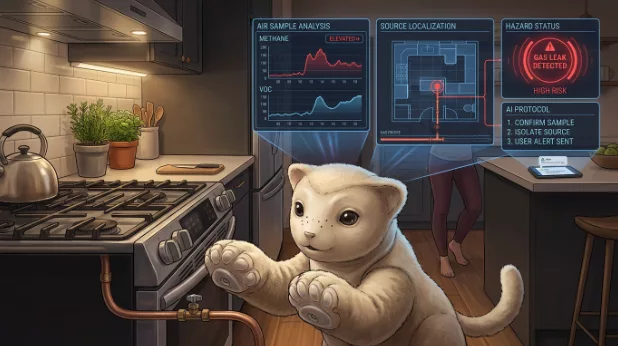
Beyond Cuteness: The Sentinel in the Living Room
The real “magic” happens when you realize these aren’t just toys; they are sophisticated edge-computing platforms. Because a physical AI pet moves through your environment, it sees what a static smart speaker cannot. A Familiar Machine can be programmed to detect environmental hazards like carbon monoxide or water leaks before they become catastrophes. (This story of a real cat who used technology to save it’s owner’s life highlights how an AI pet could save yours).
Imagine a robotic companion that notices a change in its owner’s gait or a slight tremor in their hand—early indicators of neurological issues – and quietly alerts a healthcare provider. Or, in a security context, a pet that doesn’t just bark at an intruder but intelligently identifies them and contacts the authorities while guiding the homeowner to safety. Over time, as the AI learns your preferences and habits, it transitions from a “pet” to a “personal advisor,” offering suggestions on everything from your schedule to your health, all delivered through the non-threatening interface of a loyal companion.
The Imagineering of Reality
What makes Familiar Machines and Magic so distinct from the myriads of “social robots” that have failed before (looking at you, Anki and Jibo) is the pedigree of the team. You have Colin Angle, the co-founder of iRobot and the father of the Roomba, providing the mechanical and logistical backbone. But the secret sauce is the inclusion of former Disney Imagineers.
Disney has spent a century perfecting the art of “The Illusion of Life.” They understand that a character isn’t just a set of movements; it’s a personality. By applying the principles of animation and storytelling to physical AI, Familiar Machines is moving away from the “uncanny valley” – that creepy sensation you get when a robot tries too hard to be human. Instead, they are creating “Familiars” – creatures that are unashamedly mechanical but imbued with a charm and “soul” that makes you want to protect them as much as they protect you.
Forecasting the Critical Mass of the Digital Familiar
So, when does every home have a robotic “Familiar”? We are currently in the “Apple II” phase of this industry. The hardware is reaching a price point where it’s accessible to the upper-middle class, and the AI models—thanks to the surge in generative technology—are finally capable of nuanced interaction.
I forecast that we will see this technology reach maturity and critical mass by 2029. Within the next three to five years, several factors will converge:
- Solid-State Batteries: Allowing for 24-hour “active” life without the pet constantly needing to “nap” on a charger.
- On-Device LLMs: Providing the ability for the pet to hold actual conversations and give advice without needing to send your private data to the cloud.
- Ubiquitous 6G: Ensuring that the pet is always connected to the smart home ecosystem.
By the turn of the decade, the “loneliness epidemic” will be significantly mitigated by these machines. The world will look like a place where the elderly are safer, children are kinder, and your “best friend” might just be a masterpiece of silicon and Disney magic.
Wrapping Up
The launch of Familiar Machines and Magic marks the end of the “toy” era for home robotics. By merging the rugged, real-world utility of iRobot with the emotional intelligence of Disney Imagineering, we are finally getting the companions we were promised in the 1950s. Whether it’s scaring away a pestering house cat, monitoring the health of a grandparent, or teaching a child the value of kindness, these machines are set to become an essential part of the human family. Just remember: if yours starts looking at you with glowing red eyes, it’s probably just checking the Wi-Fi, we hope…