


Sitting in my home office in the high desert of Bend, OR, watching the technology market navigate the treacherous economic waters of early 2026 has been an exercise in managing expectations. We are seeing profound macroeconomic friction across the board. Between persistent inflation squeezing enterprise budgets, consumer discretionary spending pulling back, and massive logistical bottlenecks, the hardware sector was supposed to be treading water. Most vendors have spent the past several quarters managing their own decline, offering myriad excuses for why their performance has plateaued. Yet, when analyzing the exceptional Q4 and full-year financial results recently announced by Lenovo Group, it becomes immediately apparent that they are operating on an entirely different competitive plane.
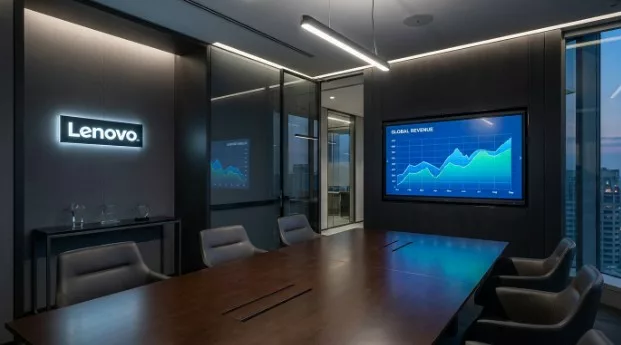
Lenovo reported an all-time fourth-quarter high of $21.6 billion in revenue, representing a staggering 27% year-on-year growth rate. This isn’t just a slight beat in a recovering market; this is their highest year-on-year growth rate in five years, with adjusted net income doubling to $559 million. For the full fiscal year 2025/26, the company delivered a record $83.1 billion. In an era where hardware margins are traditionally razor-thin and competitors are blaming macroeconomic trends for missed targets, Lenovo’s performance is nothing short of a masterclass in strategic execution, operational resilience, and technological foresight.
Defying the 2026 Tech Headwinds
To truly appreciate the magnitude of Lenovo’s $83.1 billion full-year revenue, one must properly contextualize it within the broader, highly challenged industry environment. The past year has been characterized by soaring shipping costs and supply chain disruptions that have heavily hampered hardware margins across the globe. Components remain stubbornly expensive, shipping routes have been unpredictably compromised, and the post-pandemic hardware refresh cycles have been sluggish at best. Yet, defying gravity, Lenovo achieved solid double-digit year-on-year revenue growth across all of its distinct business groups.
A significant driver of this growth stems from an acute, deeply researched understanding of user needs and the ongoing evolution of device form factors. In the commercial PC space, for instance, professional workflows have radically shifted over the past few years. There is a rapidly accelerating preference among professionals for 16-inch notebooks. I prefer 16-inch notebooks personally because the larger display makes them far closer to a desktop, drastically improving productivity without tethering the user to a desk. By prioritizing these premium, highly capable machines tailored to modern productivity demands rather than racing to the bottom with budget models, Lenovo is commanding higher average selling prices. Consequently, they are far outpacing the broader industry’s single-digit recovery.
But the real accelerant here, the engine driving this unprecedented growth, is artificial intelligence. AI-related revenue stood out as Lenovo’s leading growth engine, soaring an incredible 84% year-on-year to account for 38% of total Group revenue in the fourth quarter alone. For the full year, AI-related revenue doubled, making up a full third of their global business. This indicates something vital: Lenovo is not merely riding an industry buzzword; they are fundamentally and successfully monetizing the massive enterprise transition toward localized intelligence and high-performance computing.
The Power of Consistent Leadership
Financial results of this caliber do not happen by accident, nor are they simply the result of favorable market timing; they are the lagging indicator of years of steadfast strategic planning. One of Lenovo’s most underappreciated assets – and perhaps its strongest competitive moat – is the absolute consistency of its leadership. Under Chairman and CEO Yuanqing Yang, Lenovo has maintained a clear, unwavering trajectory for over a decade. This stability allows the company to confidently invest in multi-year infrastructure architectures and complex, globally distributed logistical networks without the chaotic course corrections that so frequently plague their rivals.
Contrast this profound stability with the broader tech landscape. You routinely see legacy technology giants playing musical chairs in the executive suite, desperately pivoting strategies with every missed earnings call or activist investor threat. Take Intel, for example, which recently had to navigate a critical transition from Pat Gelsinger to its current CEO, Lip-Bu Tan, in a necessary effort to stabilize its foundry operations and processor roadmaps. While competitors are forced to spend critical cycles restructuring their management hierarchies and re-explaining their core missions to anxious shareholders, Lenovo’s executive team remains locked in on execution. This consistency fosters deep, unshakeable trust with enterprise buyers who are looking for long-term ecosystem partners to guide their AI transitions, not just transactional hardware vendors.
The Multi-Country Advantage
Another critical pillar supporting Lenovo’s record-breaking fiscal year is its sophisticated multi-country advantage. Lenovo operates a truly globalized, hybrid model that uniquely bridges Eastern manufacturing scale with Western market sensibilities, rigorous compliance frameworks, and local support infrastructures. In a geopolitical climate fraught with tariff threats, export restrictions, and regional instability, having a singular point of failure in a supply chain is a fatal flaw that many vendors are currently paying for.
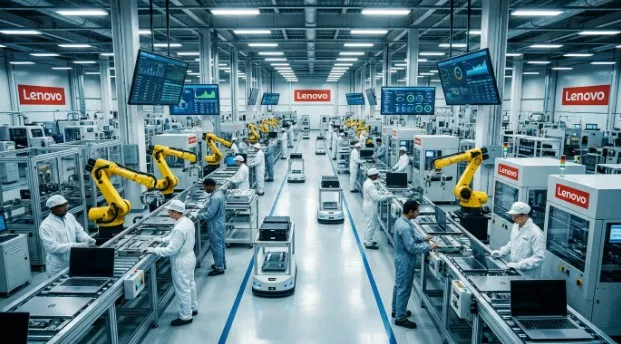
Lenovo aggressively mitigates this by maintaining a highly diversified, dynamically balanced manufacturing footprint spanning over 30 sites across multiple continents. This operational elasticity allows them to dynamically reroute production and manage component shortages – such as the memory chip constraints that have squeezed the rest of the industry – far more effectively than their peers. They aren’t just building products; they are engineering supply chain resilience as a core, defining feature of their business model. This multi-country leverage ensures that when demand spikes for their premium notebooks or their high-end, liquid-cooled servers, they have the capacity to deliver. This allows them to capture market share precisely when competitors are stuck waiting for freighters or negotiating with bottlenecked contract manufacturers.
Eclipsing Dell’s Logistics Advantages
For decades, Dell was the undisputed, widely recognized king of supply chain logistics. Their direct-to-customer model and just-in-time inventory systems were the subjects of countless Harvard Business School case studies and the envy of the manufacturing world. However, looking closely at the performance of Lenovo’s Infrastructure Solutions Group (ISG), it is abundantly clear that Lenovo has thoroughly eclipsed Dell’s historical logistics advantage.
ISG delivered its highest-ever operating profits and margins since Lenovo entered the enterprise server business. They posted a record quarterly revenue of $5.6 billion – up a massive 37% year-on-year – and full-year revenue of $19.2 billion. The momentum here is simply staggering, driven by an AI server business pipeline that has swelled to a massive $21 billion and already encompasses more than 5,800 customer AI deployments.
Lenovo has achieved this unprecedented scale by out-manufacturing and out-innovating the competition at the rack level. They have scaled their annual server manufacturing capacity to surpass 70,000 racks across AI, compute, and storage systems. Crucially, this massive output includes more than 11,000 Direct Liquid-Cooled racks, purpose-built from the ground up for the massive thermal envelopes of modern AI workloads. While Dell publicly grapples with integrating advanced cooling at scale and managing massive supply chain delays, Lenovo’s rack-scale execution is already advancing rapidly into the market. They shipped their first GB300 NVL72 racks last quarter and have their Rubin-based platforms on track for targeted time-to-market in the second half of the year. Coupled with the highly strategic acquisition of Infinidat in early April to strengthen their high-end enterprise storage capabilities, Lenovo is now actively dictating the pace of enterprise infrastructure, leaving legacy logistics champions struggling to keep up.

Internal AI Experience Drives External Success
Perhaps the most compelling aspect of Lenovo’s financial triumph is that they are their own best, most rigorous case study. Lenovo isn’t just enthusiastically selling artificial intelligence hardware; they are aggressively utilizing it internally to optimize their own sprawling logistics and manufacturing operations. When you move over 300,000 components a day through facilities like LCFC, applying AI to predict supply chain bottlenecks, optimize routing, and automate quality control yields massive, compounding efficiencies.
This internal mastery heavily informs their forward-looking product strategy. They understand better than most that the future of enterprise AI is not solely tethered to massive, latency-prone cloud deployments. Instead, they are championing the critical shift toward Agentic AI and Physical AI. By prioritizing robust local NPU performance, they are enabling secure, real-time inferencing directly at the edge. This is about deploying highly capable, autonomous agents capable of managing complex local environments and data sets without requiring constant cloud arbitration.
The clarity of this vision was palpable when I attended the Lenovo Sphere TechWorld event on the evening of January 6, 2026. The roadmap presented there wasn’t just about simple generative text bots; it was a comprehensive blueprint for Agentic AI capable of fundamentally transforming industrial workflows. For a deeper dive into this practical application, one only needs to watch how Lenovo Supercharges Enterprise AI with Agentic AI to see how organizations can deploy robust governance and automated workflows using purposeful Agentic AI platforms.
Furthermore, this internal innovation isn’t siloed in the server room. We see Lenovo’s broader device ecosystem pushing the boundaries of what is possible with concepts like Motorola’s Project Maxwell—a wearable that demonstrates how localized intelligence can revolutionize user interaction well beyond the traditional PC. By proving these complex AI concepts within their own highly complex corporate structure first, Lenovo approaches the enterprise market not just as a vendor, but as an experienced practitioner offering proven, hardened solutions.
Wrapping Up
Lenovo’s fiscal year 2025/26 results are a powerful testament to what happens when visionary leadership meets flawless operational execution. Generating $83.1 billion in a highly restrictive macroeconomic environment designed to suppress hardware growth is a monumental achievement. By leveraging a resilient, dynamic multi-country supply chain, investing heavily in the correct form factors, and pioneering the necessary shift toward Agentic AI and edge computing, Lenovo has expertly outmaneuvered the traditional tech headwinds.
More importantly, they have systematically dismantled the logistical moats of competitors like Dell, proving that superior global manufacturing and advanced thermal infrastructure at scale win the day. As the industry continues its rapid pivot from basic generative tools toward highly capable, autonomous Agentic AI ecosystems, Lenovo’s ability to internally validate and externally deliver these vital technologies positions them not just as a current market leader, but as the primary architect of the next generation of enterprise computing.