


Every decade or so, the technology industry collectively forgets a fundamental law of physics: you cannot push an ocean of data through a garden hose, no matter how efficiently you compress it. We are currently watching this exact scenario play out with Generative AI and our global cellular networks. I have been warning about the limitations of cloud-dependent architectures for years, arguing that the “dumb terminal” approach to mobile computing is fundamentally flawed when dealing with persistent, high-bandwidth data streams.
Now, the data is officially backing up the theory. Recent network diagnostics highlight a looming crisis that IT decision-makers can no longer ignore. The immediate ramifications for telecommunications, edge hardware, and component supply chains are profound, and they are about to rapidly accelerate the obsolescence of current-generation enterprise mobility strategies.

The Hidden Cost of Cloud AI on 5G Infrastructure
When 5G was rolled out, it was marketed as the ultimate connectivity panacea – a pipeline so wide that latency and bandwidth constraints would effectively vanish. However, 5G networks were primarily optimized for asymmetric traffic: heavy downlinks for streaming high-definition video and relatively light uplinks for requests and text.
Generative AI fundamentally breaks this model. Today’s enterprise AI workloads demand continuous, massive bidirectional data flows. Employees are uploading massive proprietary datasets for Retrieval-Augmented Generation (RAG), querying massive language models, and streaming continuous real-time video and audio for AI-driven analytics. According to recent diagnostic testing, these highly persistent AI workloads strain 5G infrastructure in ways carriers never modeled for. The Ookla data clearly illustrates that cell towers in dense enterprise zones are experiencing severe spectral congestion, driving up latency and degrading the experience for all users on the node.
This isn’t just a carrier problem; it is an enterprise productivity crisis. When a cloud-dependent AI application encounters network latency, the resulting “hallucinations” or processing delays destroy the user experience. The cloud simply cannot be the sole brain for real-time enterprise AI.
Vindication for Qualcomm and the Push for Edge AI
If you look closely at what Qualcomm, Apple, and a handful of other smartphone technology leaders have been doing over the past three years, it looks remarkably prescient today. Rather than relying entirely on the cloud, Qualcomm has aggressively pivoted toward integrating high-performance Neural Processing Units (NPUs) directly into their Snapdragon mobile platforms and PC processors.
This strategy is no longer just a “nice-to-have” feature; it is an absolute necessity. By processing AI workloads locally on the device—often referred to as Edge AI—smartphones and enterprise laptops bypass the 5G bottleneck entirely. Qualcomm’s approach offloads inference tasks, such as live translation, local document summarization, and ambient noise cancellation, keeping that massive data footprint off the carrier network.
This hybrid AI model, where the heavy training happens in the data center but the localized, privacy-sensitive inference happens on the user’s device, is the only sustainable path forward. It justifies the massive R&D budgets these silicon vendors have poured into edge computing capabilities. Companies heavily invested in thin-client architectures that rely exclusively on cloud processing are going to find their deployments struggling against network physics, while edge-heavy deployments will experience a massive competitive advantage in speed, reliability, and security.
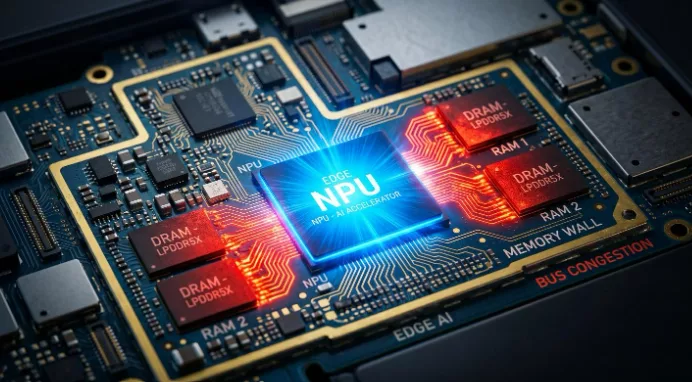
The Memory Wall Threatening Edge AI Innovations
However, pushing AI to the edge introduces a critical, potentially catastrophic supply chain chokepoint: memory. Running Large Language Models (LLMs) or sophisticated multimodal AI locally requires massive amounts of high-speed random-access memory.
Here is the problem: the global semiconductor industry is currently heavily constrained. Foundries are aggressively retooling their DRAM production lines to manufacture High Bandwidth Memory (HBM) to feed the insatiable demand for Nvidia’s data center GPUs. Because HBM yields are lower and the production process is more complex, this shift is actively cannibalizing the production of LPDDR (Low-Power Double Data Rate) memory used in smartphones, laptops, and edge devices.
This memory shortage is going to adversely impact efforts to provide more AI capability at the edge. We are already seeing price hikes in the spot market for standard memory modules. For enterprise IT buyers, this means the cost of next-generation, AI-capable endpoint devices is going to surge. Furthermore, battery constraints on mobile devices limit how much active memory can be powered simultaneously. Silicon engineers are currently battling a “memory wall,” where the computational power of the NPU far outpaces the bandwidth and capacity of the device’s onboard RAM. Without immediate breakthroughs in memory architecture, the promise of localized edge AI will hit a hard physical ceiling.
Transforming Edge Hardware and Wide Area Networks
Because mobile devices will be constrained by this memory wall, we are going to see a radical transformation in intermediary Edge Hardware and Wide Area Networks (WAN). If the smartphone can’t process the entire workload, and the cloud is too far away (and the 5G pipe too congested), the compute must move to the network edge.
We are going to see a massive proliferation of Multi-access Edge Computing (MEC) nodes installed directly in enterprise branch offices, factory floors, and at the base of cell towers. These localized AI servers will act as intelligent proxies. Hardware vendors like Dell, HPE, and Lenovo are already positioning high-density, ruggedized micro-servers designed specifically to ingest and process local AI workloads before they ever touch the broader cellular network.
Simultaneously, SD-WAN (Software-Defined Wide Area Network) architectures are undergoing a fundamental rewrite. Traditional SD-WAN routed traffic based on IP addresses and simple port protocols. The new generation of AI-native WAN networks will dynamically inspect data flows, actively dropping non-essential AI telemetry, compressing inference results, and prioritizing real-time AI API calls over standard web traffic. The network itself must become self-aware and predictive to survive the incoming data tsunami.

The Shape of Post-2030 Devices
Looking beyond the current decade, the fallout from this network strain and edge hardware evolution will dictate the design of post-2030 devices. The traditional smartphone, as a rectangular slab of glass that you poke with your finger, will likely be entirely deprecated by 2030.
Future devices will likely take the form of distributed wearables – AR glasses, intelligent earpieces, and biometric sensors—that act as fragmented input/output interfaces. These peripherals will rely on an entirely new computing paradigm called “dynamic workload partitioning.” Depending on the real-time health of the local 6G network, the battery life of the device, and the user’s proximity to a localized edge node, the device will instantly and seamlessly decide where to process a generative AI request.
We will also see the commercialization of neuromorphic computing in endpoint hardware. Because traditional Von Neumann architectures (separating CPU and Memory) are causing the current bottlenecks, post-2030 silicon will mimic the human brain, processing and storing data in the same microscopic location to drastically reduce power consumption and eliminate the memory bandwidth wall. By 2030, devices won’t just run AI; their underlying hardware architecture will be fundamentally redefined by it.
Contrary and Accelerating Trends
While the strain on 5G is driving compute to the edge, there are fascinating cross-currents in the industry that demand attention.
One highly accelerating trend is the push toward Small Language Models (SLMs). While the media obsesses over trillion-parameter models like GPT-4, developers are rapidly realizing that a highly optimized 7-billion parameter model (like Meta’s Llama 3 8B or Microsoft’s Phi-3) can easily run locally on a Qualcomm Snapdragon chip with exceptional accuracy for specific tasks. This trend directly mitigates the 5G strain, as developers abandon massive general-purpose cloud models in favor of hyper-specialized, local SLMs. It is a trend born out of necessity to bypass the exact network congestion Ookla has identified.
Conversely, a contrary trend exists within the hyperscaler ecosystem (AWS, Google Cloud, Microsoft Azure). Despite the network physics working against them, they are aggressively pushing “AI-as-a-Service” thin clients, essentially trying to brute-force the cloud AI model. They are investing heavily in custom silicon to drive down data center inference costs, hoping that specialized compression algorithms and future 6G rollouts will save their centralized business models. This creates a massive strategic war in the enterprise space: the Hyperscalers fighting to keep data in the cloud, versus silicon vendors like Qualcomm and Intel fighting to keep it on the endpoint.
In my view, the laws of physics heavily favor the edge. You cannot virtualize away the speed of light or the limits of radio frequency spectrum.
Wrapping Up
The telecom industry is waking up to a harsh reality: Generative AI is fundamentally hostile to current 5G network architectures. The recent Ookla data proving that enterprise AI workloads are heavily taxing cellular infrastructure is the canary in the coal mine. This crisis provides total validation for the localized AI strategies championed by Qualcomm and edge hardware vendors, proving that local processing is the only way to ensure reliable enterprise AI performance.
However, the transition to the edge is fraught with its own hardware hurdles, most notably a severe global memory shortage driven by competing data center demands. Solving this will require an entire overhaul of how we build wide-area networks, the deployment of intelligent micro-servers at the edge, and eventually, the abandonment of traditional mobile architectures in favor of neuromorphic, dynamically partitioned devices post-2030. The AI revolution isn’t just changing software; it is actively ripping apart and rebuilding the entire global hardware and telecommunications stack. Those who fail to adapt their IT strategies to this new edge-heavy reality will find themselves stranded on the wrong side of the network bottleneck.