

I used to build about two custom desktop systems every quarter to keep my finger on the pulse of hardware modularity and performance scaling (I don’t do that anymore because memory costs have made this practice too expensive). Sitting in my Bend office, reviewing component invoices and watching the fluctuating prices of DDR5, gives me a very localized, micro-perspective on a massive, macro-level industry crisis. Managing the cost-to-performance ratio of high-speed memory is a constant headache for the enthusiast, but what is a mere annoyance for a desktop builder has escalated into a full-blown financial catastrophe for enterprise data centers scaling up artificial intelligence.
The industry has spent the last few years obsessing over raw compute – chasing after the highest teraflops and the most advanced neural processing units. But processing power is only half the equation. You can have the fastest processor in the world, but if it is constantly sitting idle waiting for data to be retrieved from storage, you are burning capital for zero return. This brings us to the most critical, yet historically overlooked, challenge of the current generative AI era, a challenge that Advanced Micro Devices (AMD) is now addressing head-on with a fascinating strategic acquisition.
The Expanding Memory Bottleneck
To understand why this move matters, we first need to define the current memory bottleneck, often referred to in engineering circles as the “memory wall.” For decades, the performance of CPUs and GPUs has scaled at a much faster rate than the bandwidth and capacity of the memory supporting them. Large Language Models (LLMs), deep learning analytics, and virtualization workloads require vast amounts of high-speed memory, specifically Dynamic Random-Access Memory (DRAM) and High Bandwidth Memory (HBM), to hold the parameters and datasets actively being processed.
When an AI accelerator exhausts its available high-speed memory, the system is forced to swap data back and forth from much slower non-volatile storage, like NAND flash drives. This data swap introduces massive latency, completely stalling the processors. Currently, the solution to this bottleneck has been blunt-force economics: just buy more DRAM. However, this approach has hit a wall of its own. Memory now accounts for roughly 30% of total hyperscaler data center expenditure, marking a staggering fourfold increase in just a few short years. Relying purely on hardware scaling to solve the memory bottleneck is no longer economically viable for anyone outside of a sovereign wealth fund.
The Persistent Nature of the Memory Crisis
Is the memory bottleneck expected to get worse? The short answer is yes, and significantly so. The AI boom has triggered an insatiable appetite for data ingestion, and the hardware supply chain simply cannot keep pace. We are currently seeing a massive constraint on the supply side. Semiconductor foundries are incredibly complex, multi-billion-dollar facilities that take years to build and calibrate. You cannot simply flip a switch and double global DRAM output.
According to recent industry analytics, the AI infrastructure rush is driving a strategic reallocation of memory production toward high-margin, enterprise-grade components. As a result, standard DRAM supply growth is projected to remain well below historical norms, hovering around 16% year-over-year. This creates immense pricing pressure across the entire market. How long will this last? Top executives across the silicon landscape, including the leadership at NVIDIA, have publicly acknowledged that memory shortages and related supply constraints are expected to continue for several years. We are looking at a prolonged, multi-year reality where high-speed memory remains a scarce, premium commodity that dictates the upper limits of AI scalability.
Enter MEXT and Predictive Memory Tiering
Faced with a bottleneck that silicon manufacturing cannot quickly resolve, AMD has intelligently pivoted to a software-driven solution. On June 15, 2026, AMD announced its acquisition of MEXT, a California-based startup specializing in AI-driven memory optimization. Rather than trying to out-build the DRAM shortage, AMD acquired the capability to bypass it conceptually.
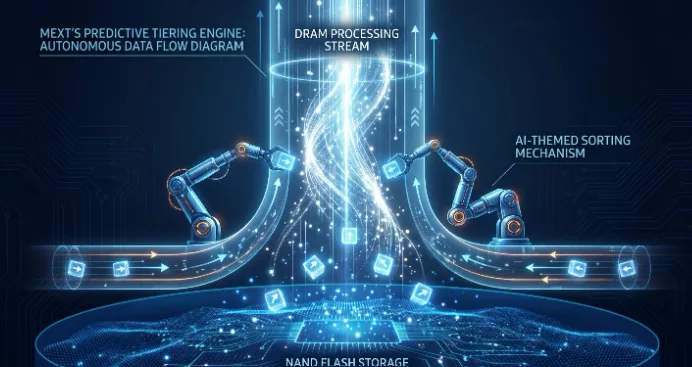
MEXT’s core technology is an AI-powered predictive memory tiering engine designed to make highly affordable NAND flash storage behave more like expensive DRAM. Traditional storage tiering is reactive; a system asks for data, realizes it isn’t in DRAM, and then goes to fetch it from flash, incurring a latency penalty. MEXT completely flips this paradigm.
By utilizing advanced machine learning algorithms, MEXT’s software analyzes a system’s memory access patterns in real time. Because enterprise workloads—like AI inference, large-scale data analytics, and server virtualization—tend to follow highly structured and repetitive data access loops, the software can effectively learn the rhythm of the workload. It then anticipates which data pages the operating system will need next and proactively moves them from the slower flash storage into the high-speed DRAM before the request is even made.
It functions much like the predictive algorithms Skynet might use in a Terminator scenario to anticipate human resistance tactics—analyzing behavioral patterns to execute a preemptive action before the adversary even moves. By successfully predicting data demands, MEXT hides the inherent latency of flash storage. The result is an infrastructure illusion: the operating system believes it has access to a massive pool of high-speed DRAM, when in reality, it is seamlessly leveraging far cheaper NAND storage.
Integration Timeline and Implementation
Of course, acquiring a technology and successfully deploying it at an enterprise scale are two entirely different endeavors. How long will it take for MEXT’s predictive engine to become fully integrated into AMD’s data center solutions?
While financial terms and exact product roadmaps are closely guarded, enterprise infrastructure moves at a deliberate pace to ensure stability. MEXT’s software must be deeply woven into AMD’s existing architecture, particularly the ROCm open software platform that developers use to optimize AI workloads on AMD Instinct GPUs and EPYC CPUs. This is not a simple driver update; it is a fundamental reworking of how the processor interacts with the memory hierarchy.
We can realistically expect to see early-stage integration rolling out to AMD’s top-tier hyperscaler partners within the next 6 to 9 months, allowing for aggressive real-world stress testing. Broad commercial availability—where standard enterprise customers can purchase AMD servers equipped with this predictive memory tiering out of the box—will likely take 12 to 18 months. AMD needs to ensure that the AI overhead required to run MEXT’s predictive algorithms does not cannibalize the processing power intended for the customer’s actual AI workloads. Once optimized, this integration will fundamentally reduce infrastructure costs and improve resource utilization across their entire enterprise portfolio.

Market Impact on AI Availability, Pricing, and Performance
The successful integration of MEXT’s technology will have profound ripple effects across the entire technology sector, fundamentally altering the economics of artificial intelligence.
First, the impact on the memory bottleneck itself will be transformative. While MEXT cannot replace the need for ultra-fast HBM in the most latency-sensitive AI training environments, it serves as a massive relief valve for AI inference, retrieval-augmented generation (RAG), and general-purpose analytics. By expanding the usable memory capacity without requiring proportional hardware expansion, AMD provides a practical way for enterprises to delay incredibly expensive hardware upgrades.
This leads directly to AI availability and pricing. Right now, building a localized AI data center is prohibitively expensive for mid-sized enterprises, largely due to memory costs. If AMD can deliver a server platform that offers DRAM-like performance using a storage array composed heavily of cheaper NAND flash, the Total Cost of Ownership (TCO) for AI infrastructure will plummet. This democratization of hardware means that advanced AI capabilities will no longer be strictly sequestered within the massive public clouds operated by Google, Microsoft, and Amazon. More organizations will be able to afford local, sovereign AI deployments, accelerating innovation across healthcare, finance, and manufacturing.
Finally, regarding performance, we are witnessing a critical shift in the AI arms race. We have officially moved beyond the “silicon wars” and entered the “infrastructure optimization war.” Raw processor speed is taking a back seat to holistic system efficiency. AMD is signaling that the future of computing performance won’t just be dictated by who can etch the smallest transistors on a wafer, but by who has the smartest software orchestrating the flow of data between those transistors.
Wrapping Up
The memory bottleneck is arguably the most significant physical constraint limiting the proliferation of artificial intelligence today. With DRAM prices skyrocketing and supply struggling to keep up with explosive demand, the industry requires innovative detours around the hardware limitations it has encountered.
AMD’s acquisition of MEXT is a brilliant strategic maneuver that acknowledges a hard truth: you cannot simply buy your way out of the current memory shortage. By leveraging AI-powered predictive software to make cost-effective flash storage perform like premium DRAM, AMD is positioning itself to offer highly efficient, lower-cost AI infrastructure. While it will take 12 to 18 months to see this fully realized in commercial data centers, the integration of MEXT’s technology promises to shatter the memory wall, ultimately democratizing AI access and redefining performance metrics for the entire enterprise computing industry.