


At its Worldwide Developers Conference (WWDC) 2026, Apple took the stage to announce a sweeping overhaul of its ecosystem’s child safety and parental control features. Built on a foundation of end-to-end encryption, strict Safari privacy permissions, and core device protections like crash protection, the company emphasized its commitment to building a fundamentally safe platform for minors. As detailed in their official release, Apple previews new child safety features, these improvements were crafted in tandem with experts in child behavior to address holistic wellbeing, encompassing digital habits alongside physical activities and sleep.
The update introduces robust age-based experiences that explicitly demand active adult supervision. Under this new paradigm, an Apple child account automatically blocks adult websites, restricts media consumption to age-safe tiers, and institutes a powerful, highly granular matrix of parental controls. Parents can now strictly limit exactly who their children communicate with and dictate which apps they are permitted to download. The update mandates that parents must actively provide permission for their children’s activities, improving oversight on what minors buy and what they browse.
Furthermore, Apple’s Screen Time received a major analytical upgrade. Moving past the legacy model of merely reporting weekly usage, the system now allows parents to enforce precise time allowances mapped directly to the recommendations established by the American Academy of Pediatrics. App availability can be tightly scheduled, ensuring that applications deemed inappropriate for the classroom are automatically blacked out while kids are in school. Screen Time is remarkably granular now, providing parents with time-of-use data broken down by individual applications. Apple has even extended this capability inside its native apps, enabling parents to tailor internal feature access to ensure appropriate usage.
While these tools are technically impressive and undeniably thorough, they spotlight a foundational flaw in Apple’s architectural philosophy. By engineering an incredibly complex dashboard that demands constant intervention, Apple has inadvertently worsened the single greatest issue plaguing digital parenting today: parents simply do not have the time to manage it all.

The Historical Failure of Parental Controls
For more than two decades, the consumer technology industry has approached parental controls with a distinct lack of empathy for the realities of modern family life. From the early days of desktop web-filtering software to the initial rollout of mobile screen-time trackers, the structural design of these systems has shifted the burden of enforcement entirely onto the parents.
The historical problem with parental controls is not a lack of features. The actual issue is that parents do not have the time, energy, or technical literacy to effectively use them. The modern household is characterized by dual-income dynamics, exhausting commutes, and the endless cognitive load of managing school, extracurriculars, and domestic duties. Expecting a parent to act as a Chief Information Officer for their household is an unsustainable fantasy. Survey data routinely indicates that while the vast majority of parents consider managing screen time a priority, they struggle to consistently enforce these rules because of the sheer effort required to maintain them.
Setup processes are notoriously opaque, requiring users to navigate labyrinthine settings menus to block specific URLs, restrict mature content, or establish daily time limits. Worse, these systems have historically been fragile. A single operating system update can reset configurations, or a child can discover an obscure workaround via a third-party proxy or a time-zone manipulation trick. When a system requires constant monitoring, troubleshooting, and manual adjustment to remain effective, it ceases to be a helpful tool and becomes an unpaid, highly frustrating part-time job. Consequently, most parents default to a policy of benign neglect, hoping for the best because the alternative is a perpetual battle against their own devices.

How Apple’s 2026 Enhancements Magnify the Time Crisis
Instead of alleviating this structural friction, the announcements coming out of WWDC 2026 effectively make the problem of not having enough time much worse. Apple has doubled down on granularity, mistakenly equating more control knobs with better protection. In doing so, they have designed a system that requires an unsustainable level of active daily management.
Consider the new real-time permission framework. Under the updated system, parents must provide permission for an ever-expanding list of digital requests. Children must ask for explicit approval not just for App Store purchases, but for individual web browsing destinations and app downloads. This means a parent’s device will be bombarded with a relentless stream of push notifications throughout the workday. Every time a child clicks an educational link sent by a teacher that triggers a false positive in Safari’s filtering engine, the parent must stop what they are doing, evaluate the URL, and grant permission. This notification fatigue leads many parents to reflexively tap “Allow” just to make pop-ups disappear, completely undermining the ecosystem’s security.
The introduction of hyper-granular Screen Time metrics and age-based time allowances sounds phenomenal in a press release, but it demands an immense amount of analytical oversight. Parents are now expected to audit time-of-use data broken down by individual applications and tailor settings within specific Apple apps.
Scheduling app availability to block non-educational tools during school hours requires parents to manually align device profiles with shifting school schedules, half-days, and seasonal breaks. Apple’s philosophy remains explicitly rooted in the premise that “parents remain in full control.” In practice, “full control” translates to “full liability and constant manual labor,” turning the smartphone into a vector for relentless friction between time-starved parents and their digitally native children.
A Better Path for Apple Shifting from Mitigation to Automation
To truly protect children without fracturing the sanity of their guardians, Apple needs to fundamentally re-engineer its approach. The goal of a modern parental control suite should be total cognitive offloading. Apple should transition from a philosophy of manual mitigation to one of intelligent automation, creating an environment that is safe by default and requires intervention only by exception.
First, Apple must leverage its vast repository of user data and behavioral insights to implement automated, crowd-sourced profile templates that adapt dynamically. Instead of forcing a parent to manually input time allowances and block lists, the device should automatically configure itself based on the child’s verified age, grade level, and local school district calendar. If a child is in the sixth grade, their device should automatically enter a standardized mode during regional instructional hours—muting entertainment apps, locking down communication to verified guardians, and white-listing educational platforms without requiring the parent to click a single button.
Second, Apple needs to move away from the disruptive, real-time push-notification approval model. Instead of interrupting a parent’s workday with dozens of isolated requests, the system should aggregate non-urgent permissions into a daily or weekly digest. If a child wants to download a new game or access a borderline website, the request should be held in a low-priority queue that the parent can review and approve en masse during a designated time, such as after dinner. Furthermore, Apple should establish an automated trust network within the OS, allowing parents to delegate approval authority to verified teachers or tutors during specific hours, ensuring that educational bottlenecks are resolved instantly without parental involvement.
Industry Examples of Low-Burden Security That Works
Apple does not need to invent this philosophy from scratch; multiple sectors of the technology industry have successfully deployed automated, low-burden control systems that get the job done without alienating the end user.
In the enterprise software space, cybersecurity giants utilize a philosophy known as conditional access and automated endpoint management. Administrators do not manually review every website an employee visits. Instead, platforms like CrowdStrike’s endpoint security suite operate on AI-driven threat intelligence that automatically categorizes risk, quarantines anomalies, and self-heals permissions in the background. If a corporate tool can seamlessly manage the security configuration of fifty thousand corporate devices simultaneously with minimal human intervention, a consumer technology ecosystem should easily be able to manage two or three devices within a single family.
In the consumer hardware space, networking companies have revolutionized home internet filtering by utilizing cloud-based, AI-driven categorization engines. When a parent sets up an eero network with eero Secure parental controls, they can assign devices to specific family profiles. The network then automatically applies real-time, zero-configuration filtering based on global threat feeds and age-appropriateness databases. The system handles millions of URL re-routes and security checks quietly in the background. It only alerts the parent if a major security boundary is crossed or if an explicit, anomalous bypass attempt is detected. These companies have proven that consumers prefer a set-it-and-forget-it architecture that relies on intelligent defaults rather than a continuous stream of micro-transactions for user attention.
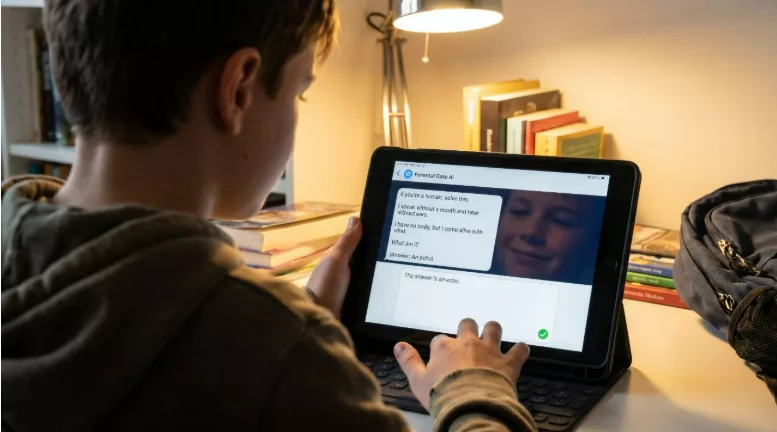
The Promises and Perils of AI-Driven Digital Parenting
The integration of advanced Artificial Intelligence and machine learning offers the ultimate pathway toward automating parental controls within Apple’s ecosystem. By embedding localized, privacy-first AI models directly onto the device, Apple could move past rigid keyword filters and static time limits toward true contextual understanding.
An AI-driven parental control system would be capable of analyzing the semantic content of messages, emails, and web pages in real time. Instead of blocking a web page because it contains a forbidden word, the AI can evaluate the context, distinguishing between a child researching biology homework and a child seeking inappropriate explicit content. Furthermore, an onboard AI can monitor behavioral patterns, automatically detecting signs of cyberbullying, predatory grooming, or radicalization by analyzing shifts in typing cadence, language sentiment, and app switching frequencies. The AI could then step in to shadow-block harmful interactions before they escalate, providing real-time defense without parent intervention.
However, relying entirely on AI introduces a dangerous point of failure: children are exceptionally adept at gaming systems. History has shown that digitally native youth possess an uncanny ability to reverse-engineer restrictions and discover exploits that adult developers overlook. It is a well-documented phenomenon that children regularly share methods to bypass Apple’s Screen Time constraints—using everything from screen recording to steal parental passcodes to exploiting time zone settings to extend their downtime limits.
If an AI is trained to detect explicit language, children will instantly pivot to complex leetspeak, obscure emojis, or deliberate typos to bypass the semantic filter. If the AI restricts access based on perceived sentiment, kids will learn to frame inappropriate queries using hyper-polite, academic language designed to soothe the algorithm into submission. They will exploit edge cases in the prompt logic, essentially conducting mini prompt-injection attacks on their own devices to unlock restricted applications or extend screen time boundaries.
Because of this inevitable cat-and-mouse dynamic, AI can never completely replace human oversight. Even with the most sophisticated automated tools, parents will still need to regularly check up on what the AI is doing. The relationship between a parent and an automated parental control system must mirror the concept of “Human-in-the-Loop” systems used in industrial automation. The AI serves as the primary operator—handling 95 percent of the daily labor, filtering out noise, and managing baseline boundaries—while the human steps in as an auditor and supervisor. Parents must periodically review the AI’s decision logs, verify that the system has not been compromised or manipulated, and look for structural anomalies that indicate their child has found an exploit. Automation minimizes the time required to manage digital safety, but it does not absolve parents of ultimate oversight.
Wrapping Up
Apple’s announcements at WWDC 2026 represent a massive technical achievement in the realm of child safety, offering unprecedented protection for families deeply embedded in the iOS ecosystem. The combination of age-based media filtering, granular app scheduling, and time limitations mapped to pediatric guidelines creates a formidable barrier against digital harms.
Yet, by building this system around an intricately manual architecture that requires parents to approve an unending sequence of individual requests, Apple has failed to account for the finite nature of parental time. True safety should not require a parent to moonlight as a system administrator.
To create lasting, systemic change, Apple must shift its design philosophy toward intelligent automation. By leveraging enterprise-grade endpoint management principles and localized AI to handle the heavy lifting, Apple can establish robust, automated defaults that self-adjust based on age and context. Only by respecting the parent’s time can Apple provide real peace of mind, ensuring that technology remains a tool for enrichment rather than a source of continuous domestic friction.