

For decades, we’ve been told that automation only comes for the “blue-collar” worker—the repetitive, manual tasks that robots could eventually mimic. We were wrong. As we look at the current labor landscape, it is the “white-collar” analyst, the middle manager, and the creative professional who are finding themselves in the crosshairs of a silicon-based revolution.
We are currently witnessing a disturbing trend of layoffs that companies are increasingly attributing to “restructuring” for an AI-centric future. From IBM’s pause on hiring for thousands of roles that could be replaced by AI, to UPS cutting 12,000 jobs while leaning into automated technologies, the message is clear: the displacement isn’t coming; it’s here.
The current labor market is deceptively “tight” in terms of numbers, but for the highly skilled, it is becoming a gauntlet. When a major tech firm sheds 10,000 workers, those individuals aren’t just competing with each other; they are competing against an ever-evolving algorithm that doesn’t require health insurance, doesn’t take vacations, and works 24/7. This makes finding a new role at a similar salary bracket incredibly difficult, as the “entry-level” roles that used to be the safety net for career pivots are being evaporated by Generative AI.

The Price Parity Trap: Why the Worst is Yet to Come
It is a common mistake to look at the current cost of running a Large Language Model (LLM) and assume humans are safe. Yes, today, high-end GPU clusters and the massive energy requirements of AI make it expensive. However, anyone who has followed the technology sector for more than a week knows the “Moore’s Law” and its various corollaries. Hardware becomes more efficient, and software becomes more optimized.
Historically, tech always follows a path from “expensive and niche” to “cheap and ubiquitous.” Currently, we are in the “expensive” phase. When the cost of an AI agent drops below the cost of a human salary – not just for the software, but for the total cost of ownership- the rate of displacement will shift from a linear progression to an exponential one. Organizations that are currently “experimenting” with AI will move to “total replacement” strategies. If you think the layoffs are bad now, wait until the cost of a digital analyst drops to $5 an hour.
The Institutional Failure of Education
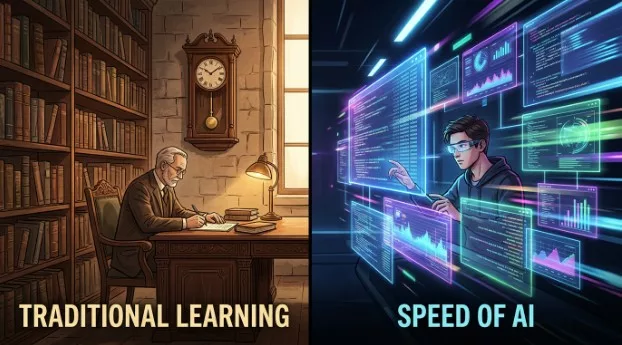
The most tragic part of this transition is that our educational infrastructure is built for a world that no longer exists. Universities are notoriously slow; it takes years to develop a curriculum and even longer to see a student through it. By the time a student graduates with a degree in data analysis or digital marketing, the tools they learned are often obsolete, replaced by an AI that can perform those functions better and faster.
As noted in a recent Yale School of Management insight, the real job destruction is hitting before careers can even start. Entry-level “on-the-job training” roles are being deleted, meaning the ladder to professional mastery is missing its first ten rungs.
Even trade schools, which are traditionally better at aligning with market needs, will struggle. While a plumber or an electrician is safer than a spreadsheet analyst, the “speed of AI” means that even these fields will see disruption in logistics, diagnostic tools, and customer management. The cycle of learning and unlearning is now faster than the traditional academic semester.
Safe Havens: Where Humans Still Hold the High Ground
If you are looking for safety, you must look toward roles that require high degrees of empathy, physical dexterity in unstructured environments, and complex, multi-variable decision-making where the “human element” is the product itself.
- The Skilled Trades (0-15 Year Safety Window): Plumbers, electricians, and HVAC technicians are safe for now. Robotics hardware is lagging far behind AI software. It is easy to write a poem; it is incredibly hard to navigate a cramped crawlspace to fix a leaking pipe.
- Specialized Healthcare (10-20 Year Safety Window): Surgeons and high-level nurses require a level of tactile precision and “bedside manner” that patients will demand for decades to come.
- The “AI Orchestrator” (The New Professional Standard): The safest role isn’t someone who ignores AI, but someone who directs it. Analysts who can manage fleets of AI agents to produce results that a single AI couldn’t achieve on its own will be the new “power users.”

Building Your Human Fortress: Advice for the Displaced
To survive this, you must stop thinking of yourself as a “worker” and start thinking of yourself as a “solution provider.” Here is how to prepare:
- Pivot to “High-Touch”: If your job involves staring at a screen and manipulating data all day, you are at risk. Move toward roles that require physical presence, negotiation, or complex stakeholder management.
- Master the Tool, Don’t Compete with It: You should be using AI to do your job 10x faster today so that you have the time to learn the skills the AI can’t do tomorrow.
- Focus on Hyper-Specialization: AI is excellent at generalities but struggles with highly specific, local, or niche contexts. Become the undisputed expert in a niche that is too small for a tech giant to train a model on, but large enough to sustain a high-value career.
- Invest in Soft Skills: In an era of perfect digital communication, the ability to build trust, show genuine empathy, and lead people through a crisis will become the most valuable currency in the world.
Wrapping Up
The transition we are entering is uncomfortable, and for many, it will be painful. The current layoffs are the “canary in the coal mine,” signaling a fundamental shift in how value is created in the global economy. As AI becomes cheaper than human labor, the pressure on traditional career paths will become immense.
However, displacement is not the same as obsolescence—unless you refuse to adapt. By acknowledging that the educational system cannot save you and that your current skills have a “sell-by” date, you can begin the work of pivoting toward roles that emphasize the uniquely human. The future belongs to those who don’t compete with the machine, but who stand atop it to see the horizon.