

The silicon landscape shifted Tuesday as Meta Platforms announced a gargantuan, multi-year partnership with Advanced Micro Devices (AMD). For years, the artificial intelligence explosion has been synonymous with NVIDIA’s green logo, but the tide is turning. Meta’s commitment to deploy up to 6 gigawatts of AMD-powered infrastructure—a scale equivalent to the power output of six nuclear reactors—is more than just a purchase order; it is a declaration of independence. By weaving AMD’s upcoming MI450 architecture and 6th Gen “Venice” EPYC CPUs into the heart of its personal superintelligence roadmap, Meta is systematically dismantling the NVIDIA stranglehold.
The Strategic Divergence: AMD vs. NVIDIA in the Meta Ecosystem
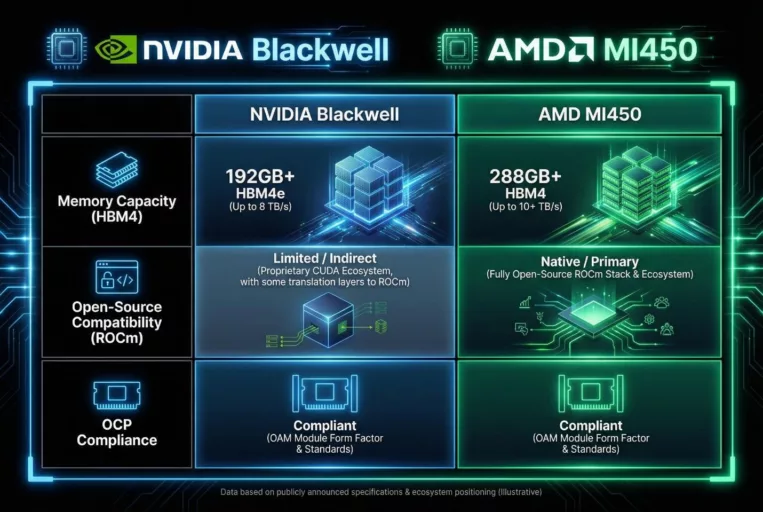
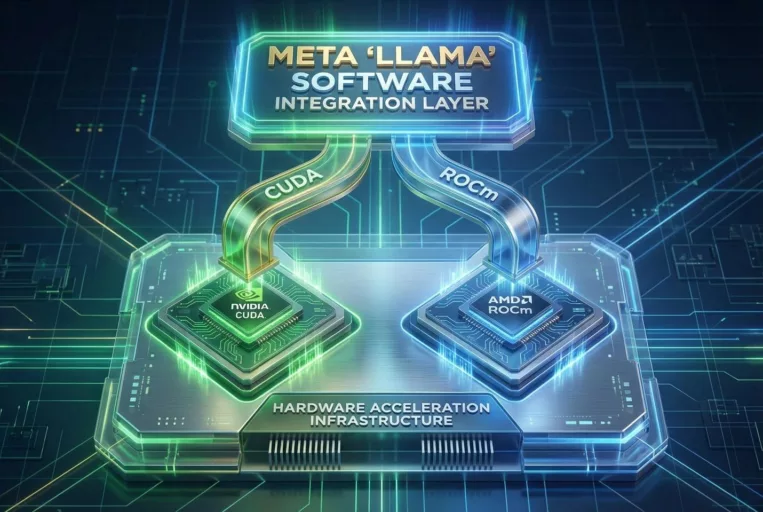
To understand the magnitude of this deal, one must look at how it differs from Meta’s existing relationship with NVIDIA. Last week, Meta doubled down on NVIDIA’s Blackwell and Rubin platforms in a deal valued at approximately $50 billion. That partnership is a “full-stack” marriage, where Meta buys into NVIDIA’s proprietary vision, including the CUDA software layer and InfiniBand networking. It is the premium, “it just works” option for the most grueling frontier model training, like Llama 4.In contrast, the AMD deal is a co-engineering masterclass. Meta isn’t just buying off-the-shelf parts; they are collaborating on a customized MI450-based GPU optimized specifically for Meta’s unique inference workloads. While NVIDIA provides the “black box” of high-performance computing, AMD is providing the “open toolkit.” This deal centers on the Helios rack-scale architecture, an Open Compute Project (OCP) compliant design that emphasizes modularity and energy efficiency. Where NVIDIA offers a locked ecosystem, AMD offers a collaborative roadmap that allows Meta to vertically integrate its software stack, ROCm, directly into the silicon.
Advancing the AMD Roadmap: From Challenger to Peer
This partnership is the ultimate validation of Lisa Su’s “AI Everywhere” initiative. For years, the critique of AMD was that its hardware was capable, but its software ecosystem was immature. By securing Meta as a lead partner for the MI400 series, AMD has gained a massive live-fire testing ground to refine its software stack.
The deal effectively pulls forward AMD’s transition into the “Tier-1” hyperscaler group. It provides the necessary capital and telemetry data to accelerate the development of unreleased products. Specifically, the MI455X and the upcoming MI500 series will benefit from the architectural feedback generated by Meta’s gigawatt-scale deployment. By the time these chips reach the broader market, they will have been “hardened” by one of the world’s most demanding AI environments, making them far more attractive to other cloud providers who were previously hesitant to stray from the NVIDIA path.
The Art of the Squeeze: Why Two Giants Are Better Than One
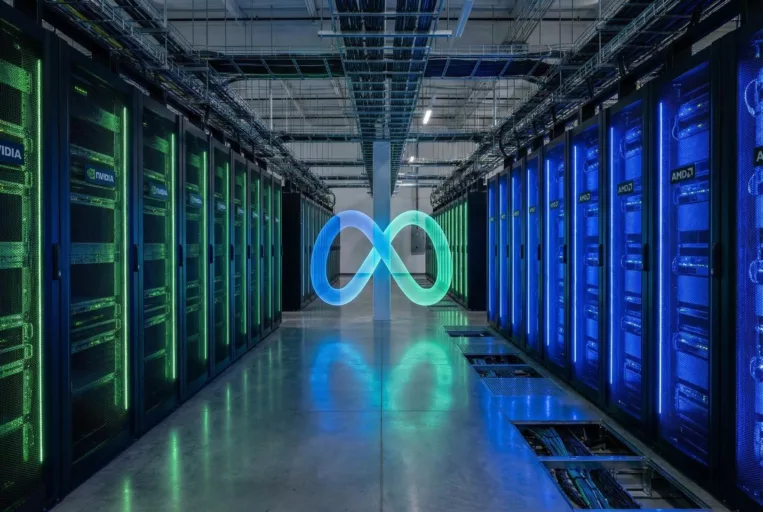
The most brilliant aspect of Meta’s strategy is the creation of a perfectly competitive duopoly. By committing tens of billions of dollars to both camps, Mark Zuckerberg has turned the AI chip market into a buyer’s market.
When NVIDIA was the only game in town, they held all the cards—pricing power, allocation priority, and roadmap control. By bringing AMD to parity in its data centers, Meta can now play the two giants against each other. If NVIDIA tries to hike margins on Blackwell, Meta can shift more of its 6-gigawatt expansion toward AMD’s Helios racks. If AMD lags on software optimization, Meta can pivot back to NVIDIA’s “Vera” CPUs. This dual-sourcing strategy is estimated to give Meta the leverage to negotiate prices up to 30% lower than a single-source customer could ever dream of, effectively saving billions in capital expenditure over the next five years.
Unreleased Power: The Impact on MI450 and “Venice”
A significant portion of this deal hinges on hardware that the public hasn’t even touched yet. The AMD Instinct MI450, built on an advanced 3nm process, is the centerpiece. This chip is expected to offer a massive leap in HBM4 memory bandwidth and FP4/FP8 compute performance. Because Meta is a “definition customer,” the MI450 is being tuned to handle the massive transformer-based models that power Instagram and WhatsApp.
Furthermore, the deal secures Meta as the lead customer for the 6th Generation EPYC “Venice” CPUs. These processors are designed to eliminate the “CPU bottleneck” often found in AI clusters, ensuring that the GPUs are never waiting for data. The synergy between the Venice CPUs and the MI450 GPUs, linked by Infinity Fabric, creates a unified compute fabric that NVIDIA’s proprietary NVLink struggles to match in terms of open-standard flexibility.
The Responsiveness Gap: Why Meta is Looking Elsewhere
There is a growing sentiment in the industry that NVIDIA has become a victim of its own success. As the undisputed king of AI, NVIDIA has earned a reputation for being “difficult” to work with—dictating terms and forcing adoption of its entire hardware/software stack.
Meta, which prides itself on its Open Compute Project heritage, finds this “walled garden” approach restrictive. AMD, in its underdog role, has been far more willing to listen. AMD’s engineers have worked side-by-side with Meta to co-develop the Helios rack and optimize the ROCm stack for Meta’s environment. This partnership sends a clear signal to Santa Clara: if NVIDIA does not become more responsive to customer needs and more flexible with its licensing and integration, it faces total displacement in the world’s largest data centers. The threat of losing a 6-gigawatt customer is the only thing powerful enough to force NVIDIA to lower its barriers.
Wrapping Up
The AMD-Meta partnership is a watershed moment for the technology industry. It effectively ends the era of the AI monopoly and ushers in an age of strategic multi-sourcing. For AMD, it provides the scale and validation needed to compete at the absolute highest level of the data center. For Meta, it provides the economic leverage to fuel its “personal superintelligence” vision without being held hostage by a single supplier’s pricing. As the first gigawatts of MI450-powered servers go online, the industry will be watching closely. If AMD can match NVIDIA’s performance at scale, the green giant may finally have to start playing by someone else’s rules.