

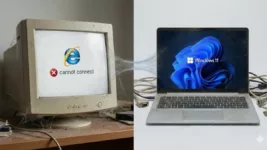
In the history of technology, there is perhaps no greater cautionary tale of complacency than the death of Internet Explorer. Once the undisputed gatekeeper of the World Wide Web with a 95% market share, it now exists only as a punchline and a technical fossil. Today, we see a chillingly similar pattern emerging with the Windows operating system. As Microsoft struggles to push a reluctant user base toward Windows 11, the platform faces a growing “IE moment” a period where a dominant product becomes so disconnected from its users’ needs that it creates a vacuum for a more agile competitor to fill.
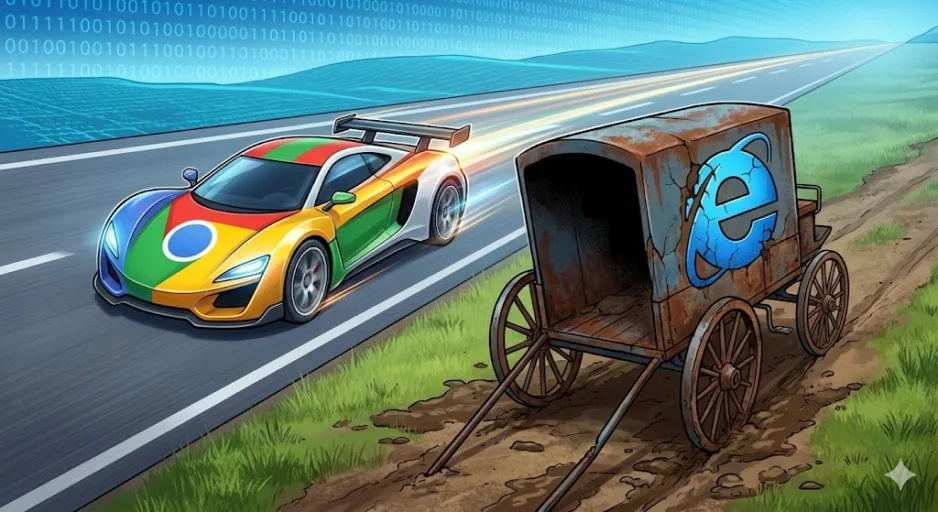
The Chrome Revolution: A Blueprint for Displacement
To understand why Windows is at risk, we must look at how Google Chrome displaced Internet Explorer. In the early 2000s, Microsoft used its OS dominance to bundle IE, effectively suffocating Netscape. However, once the competition was dead, Microsoft stopped innovating. IE became bloated, slow, and famously insecure. It ignored web standards, forcing developers to build “IE-only” sites, which frustrated the burgeoning tech community.
When Google launched Chrome in 2008, it didn’t just compete on features; it changed the paradigm. Chrome introduced the V8 JavaScript engine, which made web applications run orders of magnitude faster than they did on IE. It was minimalist, secure through sandboxing, and updated silently in the background. While Microsoft treated the browser as a static piece of the OS, Google treated it as a living service. By 2012, Chrome surpassed Internet Explorer as the world’s most popular browser. The lesson was clear: ubiquity is not a permanent defense against a superior user experience.
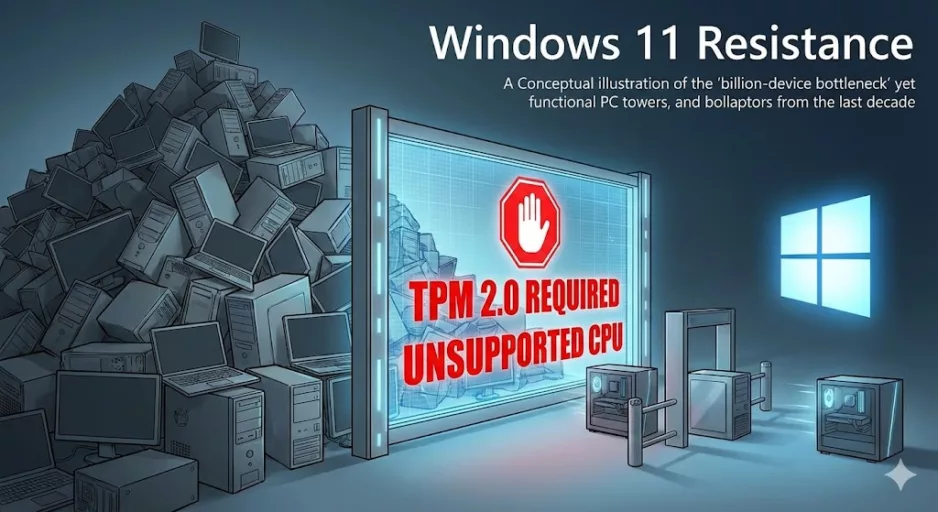
The Windows 11 Resistance: A Billion-Device Bottleneck
The parallels with the current state of Windows are striking. As of January 2026, Windows 11 has failed to achieve the dominance Microsoft envisioned. Despite Windows 10 officially reaching its end-of-life in late 2025, a massive portion of the user base—estimated at nearly 45% of Windows desktops—refuses to upgrade.
The resistance is not merely stubbornness; it is rooted in three distinct categories of friction:
- Artificial Hardware Barriers: Microsoft’s strict requirement for TPM 2.0 and specific CPU generations has orphaned hundreds of millions of perfectly functional PCs. Recent reports suggest there is a billion-device bottleneck, consisting of 500 million PCs that cannot upgrade and another 500 million that will not because users see no value in the transition.
- Unwanted Feature Bloat: The integration of AI tools like “Recall” (which originally drew heavy fire for privacy concerns) and the constant push for cloud-integrated Microsoft accounts have alienated privacy-conscious power users.
- The “If It Ain’t Broke” Factor: For the average user, Windows 11 feels like a cosmetic skin on Windows 10 with more advertising and less control over the user interface.
This stagnation leaves the platform vulnerable. When a dominant player stops serving its customers’ best interests—by forcing hardware refreshes or intrusive telemetry—users begin looking for the exit.
Assessing the Contenders: Who Wins the Desktop?
If Windows follows Internet Explorer into obsolescence, the replacement must be more than just a different brand; it must solve the problems Microsoft has created.
MacOS: The Premium Stronghold Apple is the most obvious beneficiary of Windows friction. MacOS has seen a steady climb to roughly 15-16% of the global desktop market. For users who want a “it just works” experience and are willing to pay the hardware premium, the Mac is a natural destination. However, the closed nature of the Apple ecosystem and the high entry cost mean it is unlikely to ever capture the 70%+ market share Windows currently enjoys.
Desktop Android and ChromeOS Flex Google’s strategy for the desktop mirrors its strategy for the browser: simplify. ChromeOS Flex allows users to turn aging, “incompatible” Windows 10 PCs into fast, cloud-centric machines. While “Desktop Android” remains niche, the convergence of Android apps with ChromeOS makes Google a formidable threat in the education and light-enterprise sectors. If the “browser is the OS” trend continues, Google is perfectly positioned to repeat its Chrome victory but they’ll need to market the result to get people to switch and Google is historically poor at staffing and funding marketing adequately and they have the attention span of a 4-year-old on sugar. They have the funding and the greatest potential, but their historically poor execution offsets both sharply.
The Rise of the Linux Desktop: Mint and Zorin OS Perhaps the most interesting development in 2025-2026 has been the surge of Linux. The Linux desktop share recently hit a record high of over 6%. Two distributions are leading the “refugee” movement:
- Linux Mint: Known for its “Cinnamon” desktop, Mint provides a UI that is nearly identical to the Windows 7/10 workflow. It is incredibly stable, respects user privacy, and runs beautifully on older hardware that Windows 11 rejects.
- Zorin OS: This distribution is designed specifically for Windows switchers. It includes a “Zorin Appearance” tool that can mimic Windows or MacOS layouts with a single click. Following the end of Windows 10 support, Zorin OS reported over one million downloads, with the vast majority coming from Windows users looking for a safe harbor.
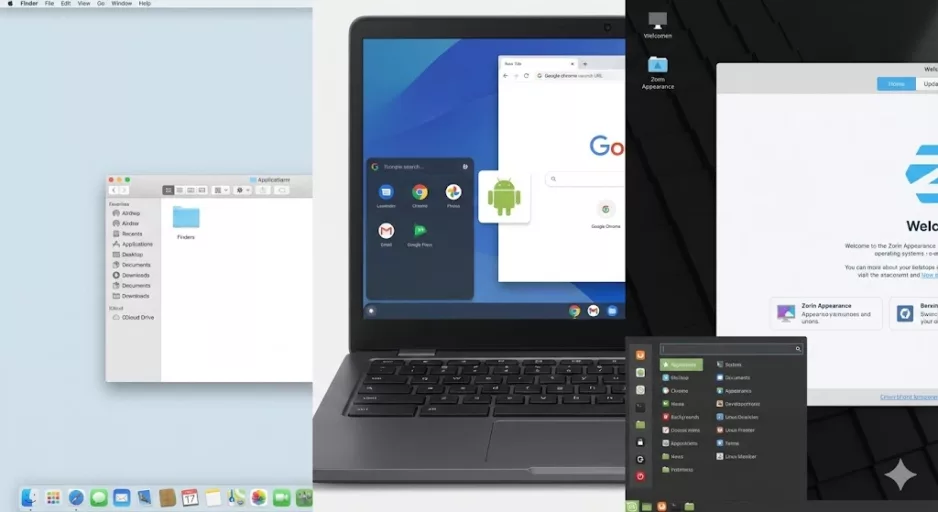
The Verdict: The Most Likely Replacement
If Windows truly collapses, no single OS will likely hold a 90% monopoly again. Instead, we will see a fragmented landscape. MacOS will dominate the high-end and creative professional space, while ChromeOS will capture the budget and education sectors.
However, for the traditional PC power user and the “orphaned” hardware market, Linux (specifically Zorin OS and Mint) is the most likely functional successor. Unlike MacOS, Linux can run on existing hardware. Unlike Android, it offers a full-powered desktop experience. For the first time in thirty years, the “Year of the Linux Desktop” isn’t a meme; it’s a migration strategy for a billion users who feel abandoned by Redmond.
Wrapping Up
Microsoft is currently walking the same path of complacency that led to Internet Explorer’s demise. By prioritizing AI telemetry and forced hardware upgrades over user trust and compatibility, they have created the perfect conditions for a mass exodus. While Windows 11 will likely remain the corporate standard for the next few years due to legacy software, the consumer and small business markets are rapidly reaching a breaking point. Whether the future is the polished simplicity of MacOS or the privacy-focused flexibility of Linux, the era of the Windows monopoly is finally drawing to a close.