

The global artificial intelligence landscape just witnessed a significant tectonic shift. Beijing-based Moonshot AI has made waves with the reported capabilities of its advanced models, including a “thinking agent” designed to perform complex, multi-step reasoning. This development, often associated with their powerful Kimi chatbot, is not just another iterative update; it represents a fundamental change in how AI operates, moving from simple question-answering to autonomous problem-solving. The emergence of such powerful models from China signals a new phase in the AI race, one where reasoning and agency are the new frontiers.
The “Thinking Agent” Revolution
At the heart of this advancement is the concept of a “thinking agent.” Unlike traditional large language models (LLMs) that predict the next word in a sequence, a thinking agent is designed to formulate a plan, execute it using various tools, observe the results and refine its plan accordingly. Reports suggest that Moonshot’s advanced systems are capable of executing an astounding 200–300 sequential tool calls to achieve a single goal. This is a massive leap from current standards, where models typically struggle with more than a handful of sequential actions.
This capability transforms the user experience. Instead of asking, “What is the stock price of Company X?”, a user could task the agent with: “Analyze the last five years of financial reports for Company X, compare its performance with its top three competitors, taking into account recent market trends, and generate a comprehensive investment report.” The AI would then autonomously break this down into hundreds of smaller steps: searching for competitors, retrieving financial documents, performing calculations, reading market news and synthesizing the information into a final document. This shift from a passive information retrieval system to an active, problem-solving partner is the promise of the “thinking agent.”
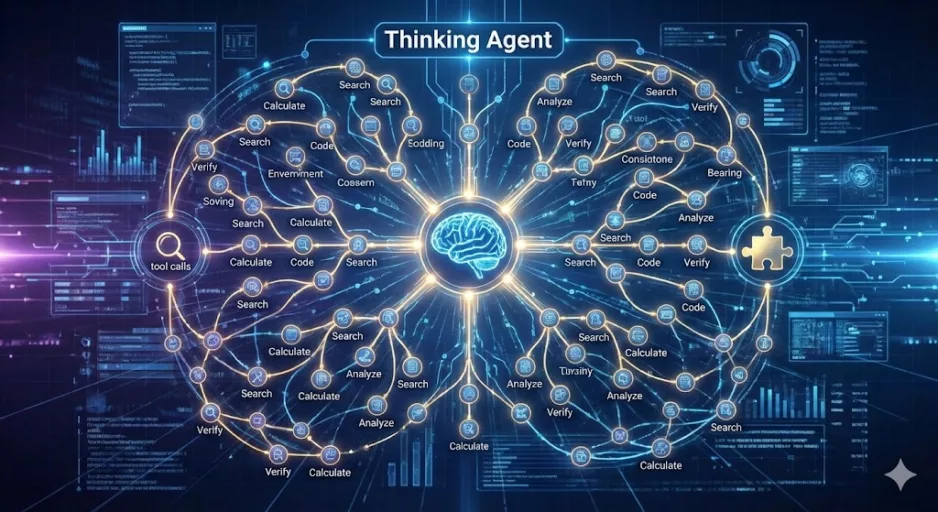
Above: A visualization of a thinking agent’s complex decision-making process, involving hundreds of sequential steps and tool calls.
Closing the Gap: China’s AI Ambitions
The significance of Moonshot’s achievement cannot be overstated. For years, the prevailing narrative was that the U.S. held an insurmountable lead in generative AI. However, the rapid rise of Chinese labs like Moonshot, which was founded in 2023, challenges this view. By developing models with such deep reasoning capabilities, Moonshot is demonstrating that Chinese AI is not just about scale but also about sophisticated architectural innovation.
The release of models with “thinking” capabilities, similar to OpenAI’s recent o1 model (codenamed “Strawberry”), shows that Chinese labs are keeping pace with, and in some aspects potentially surpassing, their Western counterparts in the race for artificial general intelligence (AGI). This is a clear indicator of a vibrant and fiercely competitive AI ecosystem in China that is quickly closing the technological gap. For more on the global AI race, see this analysis of the U.S./China AI competition.
Stacking Up Against U.S. Titans
The competition is no longer just about who has the largest model or the most GPUs. It’s about who can build the smartest, most autonomous agent. Moonshot’s focus on long-horizon reasoning and massive sequential tool use places it in direct competition with the most advanced projects from OpenAI, Google DeepMind and Anthropic.
While U.S. companies have excelled at building foundational models, Moonshot’s approach highlights a different strategic focus: building systems that can reason and act in the real world over extended periods. This capability is crucial for automating complex workflows in industries like finance, law and software development. The fact that a relatively new startup is pushing the boundaries in this specific area is a testament to the agility and ambition of China’s AI sector.
Real-World Applications: What Can it Do?
The ability to execute hundreds of sequential tool calls opens up a world of possibilities. In software engineering, an agent could be given a high-level feature request and autonomously write code spanning multiple files, debug its own errors and write test cases. In scientific research, it could formulate hypotheses, search through vast databases of papers, design experiments and analyze results.
For everyday users, this could mean a personal assistant that can plan a complex multi-city vacation, booking flights and hotels based on a set of preferences and budget constraints, all without human intervention. The move is from a conversational partner to a capable executive assistant.
The Broader Chinese AI Landscape
Moonshot AI is not an outlier but part of a larger, dynamic ecosystem. Other Chinese tech giants and startups are also making significant strides. Alibaba’s Qwen series of models, for instance, has consistently ranked at the top of open-source leaderboards, demonstrating world-class performance in coding and mathematics. DeepSeek and Zhipu AI are other key players pushing the frontiers of open-source and commercial AI models.
This collective effort, driven by intense domestic competition and strong government support, has created a formidable AI industry that is now a primary rival to the U.S. The landscape is no longer dominated by a single country but is a bipolar competition that is accelerating the pace of innovation globally.
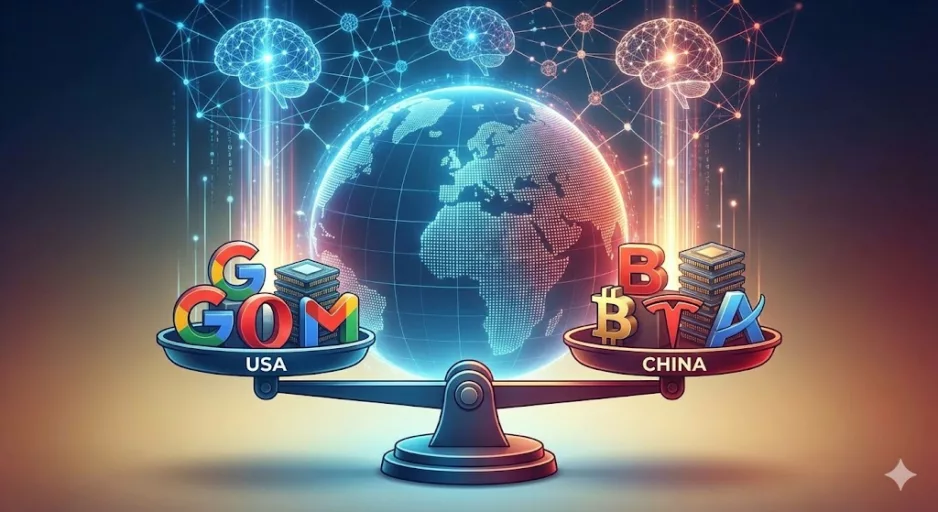
Above: A conceptual illustration of the balanced AI competition between major tech companies in the U.S. and China.
Wrapping Up
The emergence of Moonshot AI’s advanced “thinking” models is a watershed moment. It signals that the era of simple chatbots is ending, replaced by a new generation of AI agents capable of complex, multi-step reasoning and autonomous action. This development not only showcases the rapid advancements of China’s AI ecosystem but also intensifies the global competition for AI supremacy. As Chinese and U.S. labs push each other to new heights, we can expect to see an even faster rate of innovation, leading to AI systems with capabilities we are only just beginning to imagine. The future of AI is not being written in one country, but in a dynamic, high-stakes rivalry that is reshaping the technological world.