


For decades, video conferencing has been defined by a persistent, frustrating barrier: the screen. No matter how high the resolution or how low the latency, you are always acutely aware that you are looking at a flat representation of a human being. You are talking to a TV, not a person. But as I sat across from a woman who appeared to be sitting just three feet away from me—despite being hundreds of miles apart—I realized that the “glass wall” has finally shattered. This is the promise of HP Dimension with Google Beam, a collaboration that represents the most significant leap in communication technology since the invention of the telephone.
A Handshake Across the Void
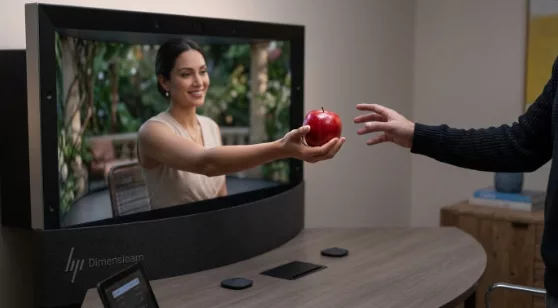
My journey with this technology began with a demonstration that felt less like a product briefing and more like a magic trick. The setup for HP Dimension uses specialized light-field display technology, similar to the anamorphic 3D electronic billboards you might see in Times Square or Tokyo, which make objects appear to float in free space or move toward the viewer.The moment of “total buy-in” happened when the woman on the other side of the link picked up an apple. She held it out toward me, and as her arm extended, the apple moved beyond the physical plane of the monitor. It was well out of the screen, rendered in full 3D with perfect depth parity. My brain didn’t see a pixelated fruit; it saw an object I could reach out and grab. This is the power of Google Beam—it provides a true-to-life sense of presence that traditional 2D video simply cannot replicate.
Beyond the Headset: Natural Interaction
One of the most profound advantages of HP Dimension is what it doesn’t require: a headset. While the industry has pushed VR and AR as the future of work, the reality is that wearing a heavy goggle set for eight hours is a non-starter for most professionals. It ruins eye contact, causes physical fatigue, and creates a barrier to the very “human” connection it tries to facilitate.
HP Dimension delivers a glasses-free 3D experience. By using advanced computational photography and light-steering optics, the system ensures that your eyes see different perspectives of the remote person simultaneously. This mimics how we perceive depth in the real world. Because you aren’t tethered to a headset, you can maintain natural eye contact, read subtle micro-expressions, and engage in the kind of deep, empathetic communication that is often lost in the “Zoom fatigue” of the modern era.
From the Home Office to the Boardroom
While the initial rollout of HP Dimension with Google Beam—slated for later in 2026—will likely target high-end enterprise environments, the roadmap for this technology is expansive. We are looking at a future line of teleconferencing products that scale to meet every need:
- The Prosumer/Home Edition: A compact, lower-cost version designed for the millions of remote workers who need to maintain a “seat at the table” without being physically present in the corporate office.
- The Executive Suite: Mid-tier systems for private offices that allow for 1:1 mentorship and high-stakes negotiations where non-verbal cues are critical.
- The Dimension Hall: High-cost, large-scale versions for conference rooms where two remote teams can be “joined” at a virtual table. Imagine a board meeting where half the team is in London and half is in New York, yet everyone feels as though they are sharing the same physical air.
Healing the Distance: Family and Legacy
The implications of this technology extend far beyond the quarterly earnings call. As these systems become more affordable, they will redefine how we maintain our most personal relationships.
Imagine a college student living thousands of miles from home. Instead of a grainy FaceTime call on a smartphone, they can sit down for “dinner” with their parents. The sense of presence provided by HP Dimension could drastically reduce the isolation often felt by remote students or elderly family members.
Taking this a step further, the integration of human digital twins and AI-driven avatars opens a door to something even more profound. By utilizing historical data and high-fidelity 3D modeling, we could eventually use this technology to “speak” with virtual celebrities, politicians, or even relatives who have passed away. While the ethical considerations are vast, the ability to have a 3D, life-sized conversation with a digital representation of a lost loved, or a living person who doesn’t have the time or bandwidth to chat with fans or constituents, one offers a level of closure and connection that a photograph or video recording never could.

Speculating on the 3D Frontier
Once we master the ability to project “presence” without headsets, the use cases for HP Dimension and Google Beam will explode into other sectors:
- Remote Medicine: A specialist in one country could virtually “stand” over a patient in another, guiding a local GP through a complex diagnostic procedure with perfect spatial awareness.
- High-End Retail: Imagine a luxury car brand or a high-fashion house “beaming” a salesperson into your living room to show you the intricate details of a product that appears to be sitting on your coffee table.
- Education and Training: Instead of watching a video on how to repair a jet engine, a 3D instructor could stand next to the technician, pointing to specific components in three-dimensional space.

Challenges and the Path to 2026
Of course, moving from a demo to a shipping product involves hurdles. The bandwidth requirements for “true to life” 3D are significant, requiring high speed connections and sophisticated compression algorithms from Google. There is also the matter of lighting and camera placement—the system must capture the user from multiple angles to reconstruct the 3D volume in real-time.
However, HP’s history of hardware engineering combined with Google’s AI and cloud prowess makes this the most “realistic” attempt at holography we’ve seen to date.
Wrapping Up
HP Dimension with Google Beam is more than just an upgrade to your webcam; it is the first step toward the “Star Trek” (Holodeck) future of communication. By removing the headset and breaking the 2D plane of the screen, this technology restores the physical and emotional nuances of human interaction. Whether it is a business leader closing a deal, a family staying together across oceans, or the preservation of a legacy through digital twins, the feeling of being “in person” is no longer a luxury of geography. When this ships in 2026, the world will get a little smaller, and our connections will become significantly deeper.