
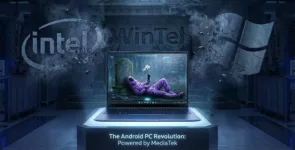
This week, I attended the MediaTek 2026 Analyst Conference, and if there was one overarching takeaway, it’s that the tech landscape is about to shift under our feet. For decades, we’ve lived in a world defined by the “WinTel” duopoly—Windows on Intel. We’ve accepted the trade-offs: high power consumption, complex legacy overhead, and a price tag that often excludes the “masses” MediaTek is so focused on reaching.
But as I sat through the presentations, it became clear that MediaTek isn’t just looking to compete; they are looking to redefine the personal computer. By leveraging their dominance in mobile and the smart edge, they are positioning the Android PC as the legitimate successor to the traditional laptop.
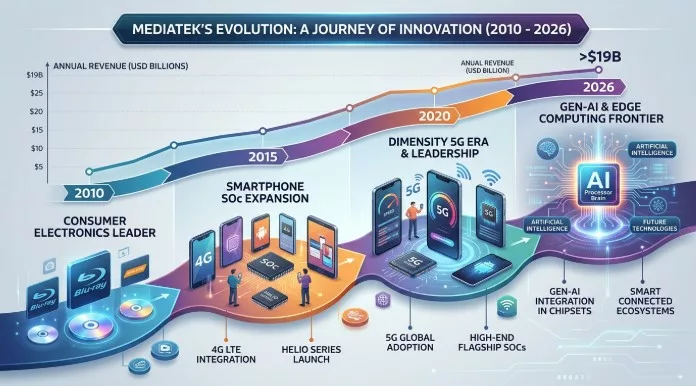
A Mission of Inclusion and Explosive Growth
MediaTek’s core philosophy is refreshingly different from the elitism often found in Silicon Valley. Their stated goal is to provide technology to the masses, not just the elite few—to “create the spark that changes a life.” This isn’t just marketing fluff; it’s reflected in their financial trajectory.
The company’s growth has been nothing short of meteoric. In 2010, MediaTek was a $3.5 billion company largely known for Blu-Ray drives and entry-level phone chips. Fast forward to the 2020s, and they’ve surged past $19 billion in revenue, according to their latest record-breaking 2025 financial results. Their most recent performance shows a 15.5% year-over-year growth, with a diversified portfolio that makes them far more resilient than the pure-play PC vendors of old.
Currently, their revenue breaks down into 59% Mobile, 37% Smart Edge (Smart TVs, Home, Connectivity, and Tablets), and 4% other. But it’s the “Smart Edge” and “Compute” sectors that are the ones to watch. Their compute business alone—which includes tablets and Chromebooks—has seen 80% growth, reaching $1 billion in revenue. This is the foundation upon which they are building their assault on the traditional laptop market.
The Coming Wave: Why the Android PC Wins
The most interesting part of the event was the focus on the “Android PC.” While MediaTek is keeping a toe in the Windows on ARM space, they are realistically assessing the hurdles there. Qualcomm has struggled to make Windows on ARM a seamless experience, hampered by emulation issues and a Microsoft ecosystem that is still deeply tethered to x86 legacy.
MediaTek is smarter. They see the writing on the wall: the next generation of users grew up on Android and iOS. They don’t want a “Start” menu; they want apps, instant-on connectivity, and battery life that lasts for days, not hours.
The Android PC—essentially a laptop form factor running a highly optimized, desktop-class version of Android—is uniquely positioned to displace WinTel for three reasons:
- Efficiency and Connectivity: MediaTek is already the market leader in 5G solutions with a 60% share. They are providing the underlying technology for SpaceX’s Starlink Mobile, which is slated to eventually eliminate terrestrial dead zones. A MediaTek laptop isn’t just “connected”; it’s a communication powerhouse.
- The App Ecosystem: Android has millions of touch-optimized, AI-ready apps. Devices like the Samsung Galaxy Tab S11 Ultra, powered by the Dimensity 9400+, prove that MediaTek silicon can bridge the gap between mobile productivity and desktop-class capabilities.
- The Energy Frontier: MediaTek’s new Genio Pro 5100 platform, which targets the IoT and Edge space, boasts a massive NPU capable of over 50 TOPS. This focus on “Performance per Watt” is their “secret sauce.” In a future where AI runs locally, the company that can deliver this without melting your battery wins.
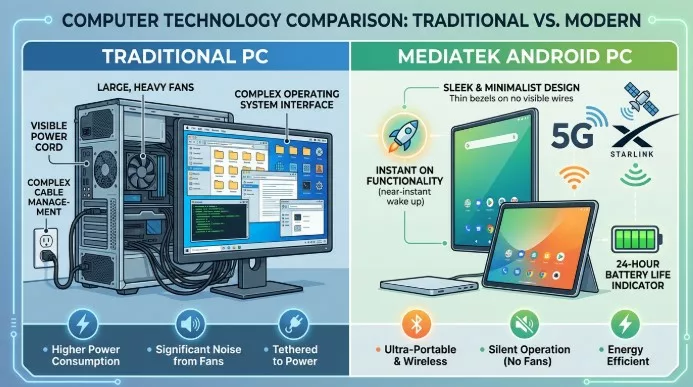
Positioning Against the Giants
MediaTek is positioned brilliantly against its competitors because they play well with others. In the Data Center space, surveys indicate MediaTek is closing in on becoming the strongest brand in their class. Why? Because while companies like Intel or NVIDIA often try to dictate the entire stack, MediaTek’s technology roadmap is built on collaboration.
They are working with NVIDIA in the automotive space (the NVIDIA SPARK project) and have massive wins with Lenovo’s new Chromebook Plus 14. Their Data Center solutions support UALink, UEC, and even NVLink, showing a willingness to integrate into existing high-performance ecosystems rather than trying to build a walled garden.
In the automotive world, they’ve already dominated the Chinese market by partnering with NVIDIA, Intelligo, and Denso. Now, they are expanding globally through partnerships with Cerence AI to bring small language models directly into the cockpit. This “partner-first” strategy allows them to scale much faster than a vertically integrated company.
The Future of the MediaTek Laptop
What does the future look like? Forecasts suggest that by 2027, the “laptop” as we know it will have diverged into two categories. There will be the heavy, power-hungry workstations for legacy enterprise work, and then there will be the MediaTek-powered “Liquid Compute” devices.
Imagine a laptop that is as thin as a tablet, completely fanless, and permanently connected to the Starlink satellite network. It won’t care about Wi-Fi dead zones because it uses MediaTek’s Wi-Fi 8 tech—which allows even older devices to access newer features like Coordinated Spatial Reuse through clever QoE optimization.
This device will be your primary AI agent. With the NPU gains showcased in the Dimensity and Genio lines, your laptop won’t just “run” AI; it will anticipate your needs, handling real-time translation and complex data analysis locally, keeping your data private and your latency near zero.
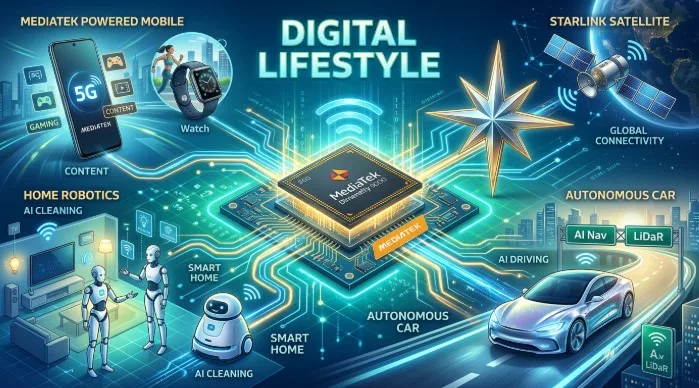
The IoT and Edge Connectivity Advantage
We cannot ignore the broader ecosystem. MediaTek’s broadband business is currently their fastest-growing segment. They are sampling 25Gb/s fiber and have 50Gb/s in the pipeline. This means the same company providing the chip in your laptop is also providing the infrastructure for the world’s fastest internet.
Their IoT wins—from Epson’s Smart Projectors to Nuwa Robotics and even Power-Pole—show that MediaTek is building a world where every device speaks the same language. When your laptop, your car (powered by MediaTek Dimensity Auto), and your home all share the same architectural DNA, the user experience becomes seamless in a way WinTel can never replicate.
Wrapping Up
The MediaTek 2026 Analyst Conference was a wake-up call for the industry. While the world has been focused on the battle between Intel, AMD, and Qualcomm, MediaTek has quietly built a global empire based on efficiency, scale, and partnership.
By focusing on the Android PC, they are skating to where the puck is going, not where it has been. They are providing the performance required for the AI era without the legacy baggage of the x86 world. With 15.5% growth, a $1 billion compute business, and a dominant lead in 5G and satellite connectivity, MediaTek is no longer an alternative—they are the future.
If I were Intel or Microsoft, I wouldn’t be looking over my shoulder; I’d be looking at the 16-inch Android laptop in the hands of the next generation. That’s where the “spark that changes a life” is actually happening.