

In the world of high-stakes technology, we often talk about “incremental gains.” We celebrate a 5% clock speed bump or a 10% reduction in thermal output. But every once in a while, a set of data points comes across my desk that suggests a fundamental shift in the fabric of productivity. The latest announcement regarding the AMD Ryzen AI PRO 400 Series isn’t just an incremental update; it’s a shot across the bow of the entire industry.
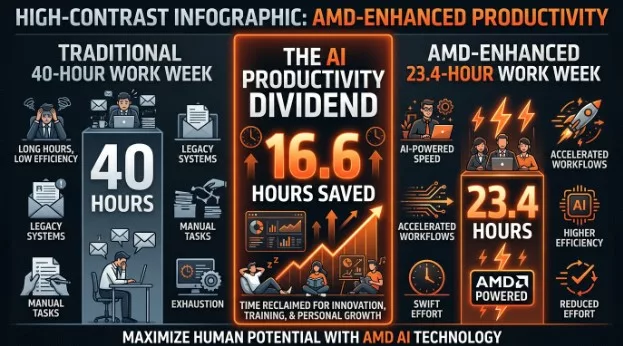
According to new data from AMD and corroborated by Principled Technologies, Project Managers—the quintessential “power users” of the corporate world—using Ryzen AI 400 systems can save up to 16.6 hours per week. Think about that for a moment. That is more than two full workdays recovered every single week through AI-offloading. By shifting background tasks like real-time transcription, automated scheduling, and complex data modeling from the CPU/GPU to a dedicated NPU (Neural Processing Unit), AMD is effectively giving its users a 40% increase in their available time.
Closing the Gap: AMD’s Sprint to the Front
For years, the narrative has been that NVIDIA owned AI, and everyone else was just playing for second place. However, AMD has closed the competitive gap with NVIDIA at a speed that should be making the folks in Santa Clara lose sleep. In the laptop and mobile workstation space, AMD has moved from a “value alternative” to a performance leader.
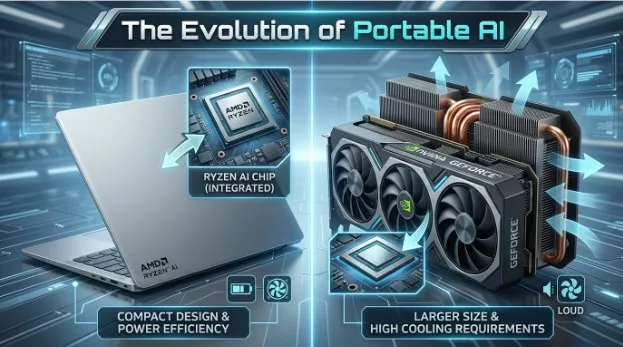
Where AMD is currently more than competitive—and arguably leading—is in the integration of the NPU within the X86 architecture. The Ryzen AI 400 series features the XDNA 2 architecture, which delivers up to 50+ NPU TOPS (Trillions of Operations Per Second). NVIDIA’s strength remains in discrete GPUs, but for the mobile professional who needs battery life and portability, lugging around a power-hungry RTX 50-series card just to run a local LLM is becoming increasingly unattractive. AMD’s “all-in-one” SoC (System on Chip) approach is proving to be more elegant for the 90% of business users who need AI assistance without the thermal throttle.
The NVIDIA Fortress: Where the Green Team Still Holds the High Ground
Despite AMD’s massive strides in the “AI PC” category, they aren’t yet the kings of the hill in every room. NVIDIA still maintains a significant lead in the software ecosystem and high-end data center training.
The CUDA moat remains NVIDIA’s greatest defense. Most AI developers still default to CUDA-optimized libraries. While AMD’s ROCm (Radeon Open Compute) is improving rapidly, it hasn’t yet reached the “it just works” status that NVIDIA enjoys across every creative and scientific application. I expect AMD to close the software gap significantly within the next 24 months as Microsoft’s Copilot+ ecosystem forces a more hardware-agnostic approach, but for now, NVIDIA holds the software crown.
Additionally, in the ultra-high-end discrete graphics space (the desktop workstation), NVIDIA’s raw TFLOPS still outpace AMD’s integrated solutions. AMD will likely close this gap by the third generation of their AI-dedicated chipsets, but it will require a continued aggressive partnership with ISVs (Independent Software Vendors).
The Strategy for Dominance: What AMD Must Do Next
To get the full benefit of their current performance advantages, AMD needs to move beyond the spec sheet. They have the silicon; now they need the “Apple-level” marketing to tell the human story. They need to stop talking about TOPS and start talking about “Family Time” or “Strategic Planning Time” regained.AMD deserves immense praise for their execution of the Zen 5 architecture. They didn’t just make a faster chip; they made a smarter chip that understands the power-envelope constraints of a modern office. Their decision to pivot hard into NPUs before NVIDIA could respond in the laptop space was a masterstroke of tactical planning.
NVIDIA’s Blind Spot: A Giant Asleep?
What does NVIDIA need to do to hold AMD off? They need to stop treating the PC market as a secondary concern to their H100/B200 data center business. Right now, NVIDIA seems so intoxicated by their $3 trillion market cap and data center dominance that they appear largely unaware of the erosion happening at the “edge” of the network—the laptops in the hands of Project Managers.
If NVIDIA doesn’t respond with a more power-efficient, NPU-centric mobile strategy soon, they risk being relegated to the “server room” while AMD takes over the “boardroom.” There is a palpable sense that NVIDIA believes their brand loyalty will save them. History is littered with companies—IBM, BlackBerry, Nokia—that believed the same thing right before they were disrupted.
The Five-Year Horizon: A Shift in the Balance of Power
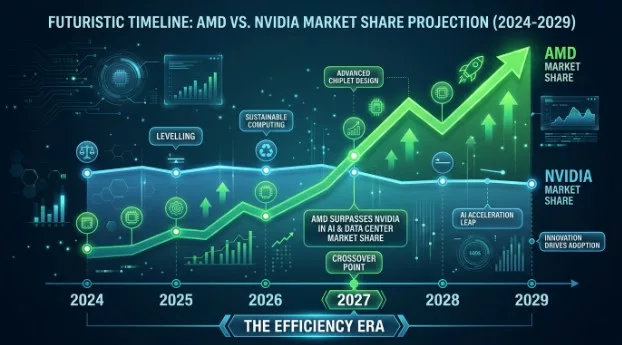
If AMD continues to out-execute NVIDIA at this current pace, the landscape in five years will be unrecognizable. We are looking at a future where AMD becomes the default standard for the “AI Workstation.”
By 2030, if this trajectory holds:
- Market Share Flip: AMD could command over 50% of the premium enterprise laptop market.
- The End of the Discrete GPU for Business: The “NPU-on-SoC” will become so powerful that discrete GPUs will be niche tools for high-end video editors and gamers only.
- Software Parity: AMD’s investment in open-source AI frameworks will likely have neutralized the CUDA advantage, making the hardware’s efficiency the only meaningful metric for buyers.
If NVIDIA doesn’t pivot to a “mobile-first” AI strategy, they may find themselves as the “Intel of 2015” – dominating a high-end market that is slowly being eaten from the bottom up by a more agile, more efficient competitor.
Wrapping Up
AMD has done something remarkable. By focusing on the specific needs of the power user and the “Project Manager” demographic, they have found a way to quantify AI value in hours, not just cycles. The 16.6-hour-per-week claim is a game-changer for corporate procurement. NVIDIA is still the king of the data center, but in the trenches of daily productivity, AMD is currently winning the war of execution. Unless NVIDIA wakes up to the threat posed by Ryzen AI, they may find that the PC market has moved on without them.