

AMD released their financial report this week and they blew the doors off with a surprise bump from China (though they would have still surprised even without that bump). However, the Q4 2025 earnings calls for AMD and Intel felt like reports from two different centuries. AMD, led by Dr. Lisa Su, reported record revenue of $10.27 billion for the quarter, driven by a massive 39% year-over-year surge in data center revenue. Their MI300 and the newer Instinct MI325X accelerators aren’t just “alternatives” to NVIDIA anymore; they are becoming staples for hyperscalers who are tired of being beholden to a single supplier.
Conversely, Intel’s Q4 2025 was a exercise in “managed disappointment.” Revenue slid to $13.7 billion, down 4% year-over-year, and the company posted a net loss of nearly $600 million. While Intel’s Data Center and AI (DCAI) group saw a modest 9% bump, the company is bleeding cash to fund its foundry ambitions. The departure of Pat Gelsinger earlier in 2025 and the subsequent focus under Lip-Bu Tan has stabilized the ship, but Intel is currently a company undergoing open-heart surgery while trying to run a marathon.
The Elephant in the Room: NVIDIA’s 2026 Dominance
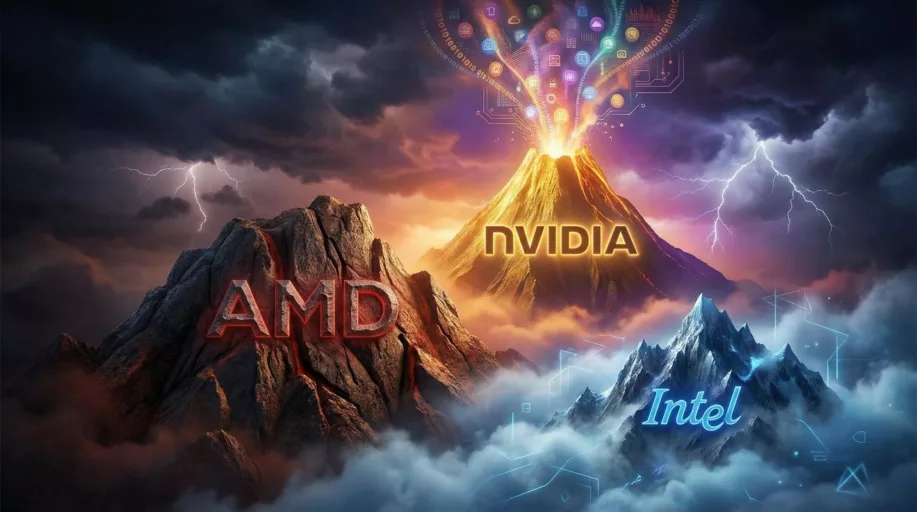
Comparing AMD and Intel to NVIDIA at this point feels less like a market analysis and more like comparing local weather patterns to a supernova. NVIDIA’s Q4 2026 results (ending January 2026 and reporting on February 25th, 2026) are expected to hit a jaw-dropping $65 billion for the single quarter. To put that in perspective, NVIDIA is now generating more revenue in three months than Intel earns in an entire year.
The driver here is the Blackwell architecture and the rapid ramp-up of Vera Rubin systems. While AMD is fighting for a 10-15% slice of the AI accelerator pie, NVIDIA has effectively become the “OS” of the AI world through CUDA. They aren’t just selling chips; they are selling entire AI factories.
The Trade War Wildcard and Geopolitical Turmoil
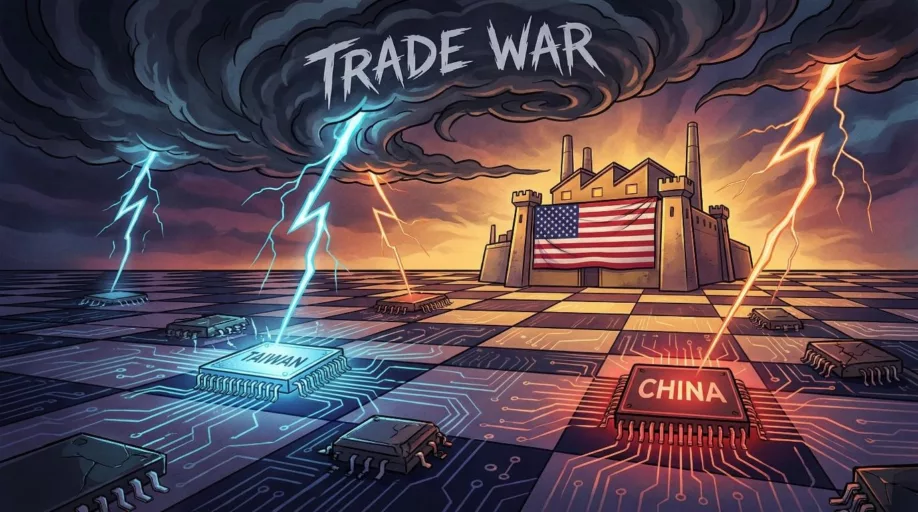
As we move into 2026, the “Silicon Shield” is under pressure. The recent executive orders imposing 25% tariffs on advanced chips (like NVIDIA’s H200 and AMD’s MI325X) have sent shockwaves through the supply chain.
- AMD is nimble, but heavily reliant on TSMC. Any escalation in the Taiwan Strait or further trade restrictions on China (which still accounts for a significant portion of their “embedded” and “gaming” revenue) could cap their upside. It is interesting to note that even without the surprise revenue and profit gain from China sales, AMD would have still beat the street with this revenue report.
- Intel, ironically, might be the best positioned for “National Security” play. With their 18A process node finally reaching high-volume manufacturing in Arizona, they are the only player that can offer a “Made in America” cutting-edge silicon solution. If the trade war turns into a full-scale blockade of Asian-made chips, Intel becomes the only game in town.
- NVIDIA has the most to lose in raw dollars but the most “moat” to protect them. They’ve already started paying “volition” fees to the U.S. government (AMD is negotiating with the US Government for the same fees) to keep shipping to China, essentially treating tariffs as a cost of doing business.
Projecting the 2026 Competitive Landscape
Looking forward, I expect AMD to continue eating Intel’s lunch in the server CPU space. Their EPYC processors are simply more efficient, and with Intel’s 18A yields still hovering in the 55-65% range, AMD has at least another year of clear runway.
Intel’s survival depends entirely on external customers like Microsoft and Amazon actually using their foundry. If Intel can get their yields above 70% by mid-2026, they might actually survive as a split company—Fab and Fabless. If not, we might be looking at the eventual breakup of the greatest silicon icon in American history.
NVIDIA will continue to grow, but the “Law of Large Numbers” will eventually catch up. You cannot grow at 60% YoY forever when you are already a $4 trillion company. The risk for NVIDIA isn’t competition from AMD; it’s the risk that the AI ROI (Return on Investment) doesn’t materialize for their customers fast enough to justify the next $100 billion in GPU orders and companies like Microsoft have complained they can’t deploy the part (Blackwell) because it is too power intensive.
Wrapping Up
The semiconductor market in 2026 is no longer about who has the fastest clock speed; it’s about who has the most resilient supply chain and the best AI software stack. AMD is the execution king, Intel is the geopolitical phoenix (trying to rise from the ashes), and NVIDIA is the sun around which everything else orbits.
The coming year will be defined by how these giants navigate the “Trump Tariffs” and whether the AI revolution stays in the data center or successfully migrates to the “AI PC” and robotics—areas where Intel and AMD still have a fighting chance to reclaim ground.