

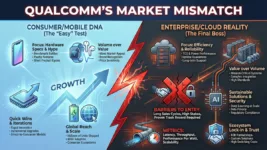
Qualcomm is the undisputed sovereign of mobile connectivity. For over a decade, Snapdragon has been the heartbeat of the Android ecosystem, a technical marvel of efficiency and integration. Yet distinct from Qualcomm’s mobile triumphs, it has a haunting history of struggling to break out of its cellular silo. As the company pivots toward the lucrative AI cloud data center market, the writing is unfortunately already on the wall.
By analyzing the historical playbook of successful market disruption—and Qualcomm’s recent inability to execute it in the laptop space—it becomes clear that its data center effort is likely destined for the same underwhelming fate as its AI PC initiative.

The Playbook for Dethroning Giants
To understand why Qualcomm is struggling, we must first look at what success looks like. Displacing a dominant market leader is not about matching specifications; it is about changing the gravity of the ecosystem. History provides clear examples of how this is done, and in every case, it required a “killer app” available at launch.
When Microsoft decided to enter the console market, Sony’s PlayStation was an unstoppable juggernaut. Microsoft didn’t just ship a box with a hard drive; it secured Bungie and Halo: Combat Evolved. It understood that hardware is merely a stage for software. Without Halo, the Xbox would have likely been a footnote. Microsoft ensured that on day one, there was a compelling, exclusive reason to abandon the incumbent.
Apple followed a similar trajectory with the iPod and iPhone. The iPod was not the first MP3 player, but it was the first to launch with the iTunes ecosystem, solving the music acquisition problem that plagued early rivals. Later, the iPhone’s dominance wasn’t secured by the touchscreen alone, but by the rapid deployment of the App Store. Apple ensured that developers had a lucrative reason to populate its hardware with utility. In both cases, the “newcomer” didn’t just offer an alternative; it offered a complete, superior reality that the incumbent couldn’t immediately replicate.
The Transmeta Trap: The Danger of Premature Announcements
Conversely, the tech graveyard is littered with companies that ignored the importance of timing. The most pertinent warning for Qualcomm is the saga of Transmeta.
In the late 1990s, Transmeta promised to revolutionize computing with chips that were drastically more power-efficient than Intel’s, using software “code morphing” to translate x86 instructions. However, Transmeta made a fatal error: it announced its revolution far too early and generated years of hype before it had a shippable product or a verified ecosystem.
This premature celebration gave Intel the one thing a monopoly should never be gifted: time. Alerted to the threat of low-power computing, Intel pivoted, pouring resources into what eventually became the Centrino platform. By the time Transmeta finally shipped, Intel had neutralized the advantage. Qualcomm appears to be suffering from this same “announcement-itis,” telegraphing its punches at NVIDIA years before it can land them, giving the AI giant ample time to fortify its CUDA moat.
The AI PC Stumble: Failing the “Easy” Test
Qualcomm’s current struggle to gain traction with the “AI PC” and Copilot+ initiative is the smoking gun for future cloud struggles. This should have been the easy win, particularly if it had (which it didn’t) leveraged its connectivity advantage.
Consider the landscape: The modern laptop market is incredibly similar to the tablet market where Qualcomm already shines. The customers are identical; the person buying a high-end iPad Pro is the same demographic buying a Dell XPS or Surface Laptop. The channels are identical; these devices are sold in the same Best Buy aisles, the same carrier stores and arguably have the same supply chain logistics. Even the form factors—slabs of glass and metal with keyboards—are converging.
Despite these massive advantages and the “home court” feel of consumer electronics, Qualcomm’s AI PC launch has been fraught with compatibility issues and consumer apathy. It launched without a “Halo” moment. There was no single application that ran so much better on Snapdragon than on Intel/AMD that it forced a switch. Instead, users were asked to tolerate emulation layers and gaming incompatibilities for the sake of battery life—a trade-off the market has largely rejected.
If Qualcomm cannot leverage its massive mobile dominance to succeed in a market that is 90% identical to its core business, the prognosis for a market that is 100% different is grim.

The Data Center Cliff: A Different Beast Entirely
This brings us to the data center. If the AI PC was an adjacent neighborhood, the AI data center is a different planet.
The similarities that existed in the PC market—channels, customers, form factors—are non-existent here. Qualcomm cannot sell AI server chips at Verizon or Best Buy. The customers are not consumers, but hyperscalers like AWS, Google and Azure, along with CIOs of Fortune 500 companies. These buyers do not care about “all-day battery life.” They care about Total Cost of Ownership (TCO), software stability and developer velocity.
The barrier to entry here is not hardware; it is NVIDIA’s CUDA. CUDA is the operating system of AI. It is a fifteen-year-old fortress of libraries, tools and optimized kernels. For Qualcomm to win, it doesn’t just need a chip that is 10% faster or cheaper; it needs a software stack that allows a developer to switch from NVIDIA to Qualcomm with zero friction.
Currently, Qualcomm’s data center offering lacks this. It’s trying to sell a standalone hardware solution to a software problem. Just as it failed to ensure top-tier games ran perfectly on its AI PCs at launch, Qualcomm seemed unprepared to ensure that the sprawling landscape of AI frameworks runs flawlessly on its cloud silicon. It’s walking into the most hostile market in tech without a map.
What Qualcomm Must Learn to Survive
If Qualcomm hopes to break this losing streak, it must undergo a radical philosophical shift.
First, it must learn silence. Stop announcing “NVIDIA Killers” three years out. Develop in the dark, build the alliances and launch only when the strike can be fatal.
Second, Qualcomm must prioritize software over silicon. The reason the iPhone worked was the App Store; the reason Xbox worked was Halo. Qualcomm needs to pay developers, acquire software firms and build a library of optimized models that makes its hardware the only logical choice for specific workloads. It cannot rely on open-source goodwill to build its drivers.
Wrapping Up
Qualcomm is a titan of mobile, but its repeated inability to translate that success into adjacent markets points to a fundamental misunderstanding of how ecosystems are built. It’s attempting to replicate the “Transmeta” model—hype and hardware specs—rather than the “Xbox” model—ecosystem and killer apps. The AI PC was the test run, a relatively simple transition that Qualcomm is currently fumbling. The data center is the final boss, a market with zero leverage points for a mobile-first company. Unless Qualcomm can fundamentally alter its DNA to become a software-first ecosystem builder, its cloud efforts will likely dissolve into the same vaporware history as its predecessors.