


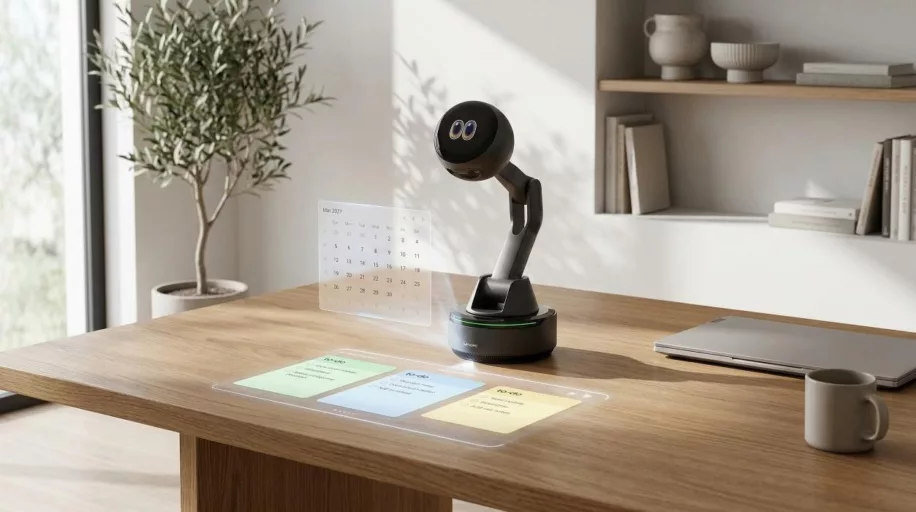
The “AI PC” has dominated headlines for two years, but we are finally moving past the era of chatbots living in a browser tab. At MWC 2026, Lenovo unveiled a vision for the future that feels less like a software upgrade and more like a new category of office furniture. The Lenovo AI Workmate Concept isn’t just another assistant; it is a robotic, “always-on” desk companion designed to bridge the gap between our physical movements and our digital work.
While competitors focus on “Agentic AI” that clicks buttons in the cloud, Lenovo is betting on Spatial AI—the idea that your desk, your printed documents, and even your hand gestures are the primary interface for the next decade of computing.
The Evolution of Lenovo’s AI Ambition
Lenovo is no stranger to digital assistants, but its journey has been one of quiet persistence. Long before the current generative AI explosion, Lenovo experimented with early iterations such as Lenovo Voice and the Alexa-powered Smart Assistant. However, those were peripheral.
The real shift began in early 2026 with the introduction of Lenovo Qira, a unified “Personal Ambient Intelligence” ecosystem. Unlike previous attempts, Qira is integrated at the system level across PCs and Motorola smartphones, focusing on on-device processing via the Personal Knowledge Base (PKB). The AI Workmate is the physical manifestation of this ecosystem. Lenovo is uniquely positioned to win this space because they own the hardware; they aren’t just building a “brain”—they are building the body that houses it.
Comparing the 2026 AI Assistant Landscape
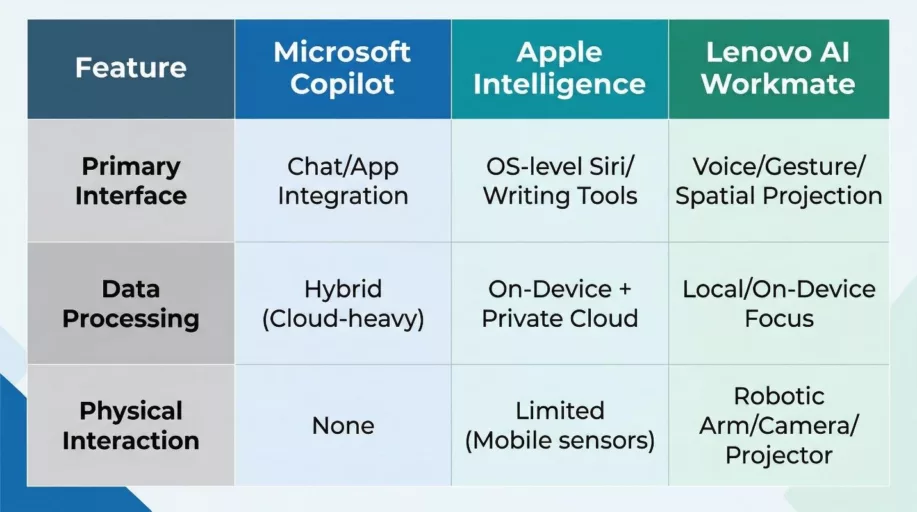
The market for personal AI assistants is projected to reach approximately $37.7 billion in 2026. As we move through this year, the competition has split into three distinct “kingdoms”:
- The Cloud Titans (Google Gemini & Microsoft Copilot): Google Gemini and Microsoft Copilot remain the kings of big data, unparalleled at scanning “the whole library” of your corporate files. However, they remain largely “screen-bound.”
- The Privacy Loyalists (Apple Intelligence): Apple focuses on seamless, secure integration within the iPhone and Mac ecosystem. It is excellent for “Smart Writing,” but lacks a physical presence in the room.
- The Physical Pioneers (Lenovo AI Workmate): This is where Lenovo carves its niche. While ChatGPT helps you write an email, the AI Workmate helps you scan a physical stack of papers on your desk, summarizes them locally, and projects the resulting PowerPoint outline onto your wall.
The Feature Set: Spatial and Physical AI
The AI Workmate Concept stands out because it treats the physical environment as a canvas. Its feature set is designed for the high-pressure professional who is tired of toggling between windows:
- Spatial Interaction & Projection: Using built-in projectors, it can “extend” your monitor. If your screen is full, it projects your Slack notifications or a document summary onto your desk surface.
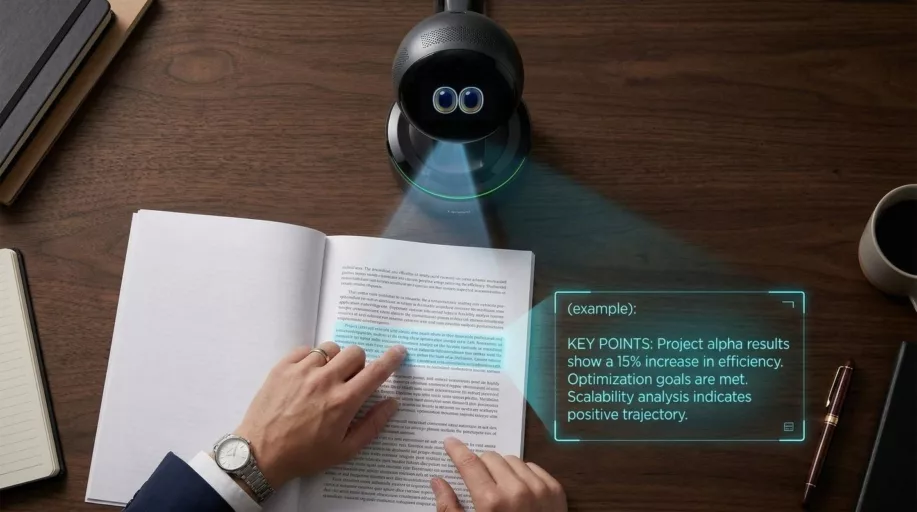
- Document Summarization: It features a high-resolution camera that can scan a physical document placed in front of it, instantly converting it into a structured digital summary or a slide deck.
- Gesture Control: Instead of reaching for a mouse to dismiss a notification, a simple wave of the hand tells the Workmate to snooze or file the alert.
- Privacy-First “Always-On”: Because processing is handled by the NPU on the device, it can remain “always-listening” for voice commands without the privacy anxiety of cloud-based speakers.
Fitting Into the Future of Work
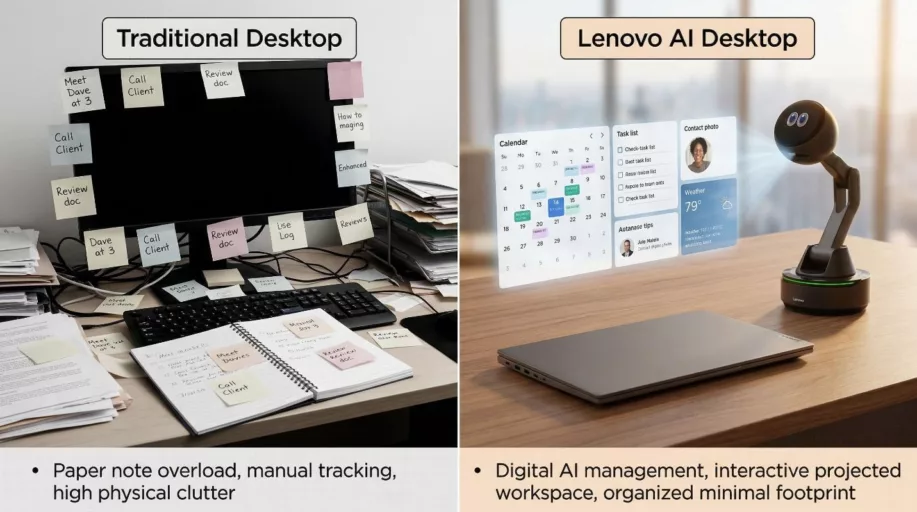
In a 2026 workspace, human-centric design is a top priority. The AI Workmate fits this trend by acting as a “buffer” between the user and their screen. It reduces cognitive load by handling the “drudge work”—organizing notes, monitoring screen time, and reminding users to take breaks—through natural interaction rather than jarring pop-ups.
For the home office, it acts as a central hub. It synchronizes schedules across multiple family devices and can transition into a “Work Companion” mode—a clock-like form factor (inspired by the Lenovo AI Work Companion Concept) that manages your daily plan with one-click automation.
The Roadmap to Success: Strategy and Pricing
To move this from a “Concept” to a market leader, Lenovo must avoid the “gadget” trap. Here is the recommended blueprint:
- Open API for “Physical Macros”: Lenovo should allow developers to create “Physical Macros.” Imagine a photographer placing a memory card on the desk, and the Workmate automatically projects an “Import and Edit” button.
- Seamless Integration with “Aura Edition”: The Workmate must be the “sidekick” to Lenovo’s Aura Edition PCs. If it doesn’t feel like a natural extension of the ThinkPad, users won’t adopt it.
- Enterprise Security Certification: Since the Workmate “sees” your desk, Lenovo must obtain top-tier security certifications to convince IT departments the camera isn’t a vulnerability.
Pricing Strategy: To compete with high-end peripherals, Lenovo should offer two tiers:
- AI Workmate Pro ($599): The full robotic-arm version with projection and spatial sensors. This is priced as a premium productivity tool, similar to a high-end monitor.
- AI Work Companion ($199): The “clock-style” version focusing on voice and scheduling without the robotics.
Wrapping Up
The Lenovo AI Workmate Concept is a bold declaration that the future of work isn’t just about faster chips—it’s about physical-digital harmony. By leveraging its massive hardware footprint and moving AI processing onto the device via Qira, Lenovo is building a unique value proposition that Microsoft and Google cannot easily replicate.
If Lenovo can price the Pro model under $600 and prove that its spatial projection is more than just a gimmick, they won’t just be selling a companion; they will be defining the hardware architecture of the AI era.