

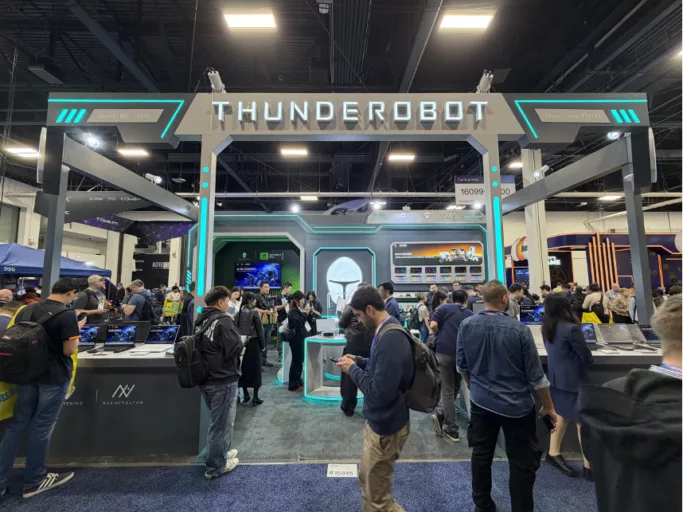
Recently, at the Consumer Electronics Show (CES 2026) in Las Vegas, thousands of brands from around the world showcased their cutting-edge technologies and products. Among them, ThundeRobot, located at booth 15845, attracted numerous tech enthusiasts, esports players, and media with its lightweight gaming laptops, Mini PCs, peripheral products, and a future-tech-themed booth design.
Laptop: Breaking the Conflict Between Portability and Performance
At CES, the ZERO Air was one of the most highly anticipated new products from THUNDEROBOT. This product attempts to provide a new solution in a dimension that has long been considered difficult to balance: achieving a dual full power release of 160W (CPU 45W + GPU 115W) within a body weighing approximately 1.58kg and measuring 15.9mm in thickness.
The ZERO Air features an Intel® Core™ Ultra Series 3 processor and an NVIDIA® GeForce RTX™ 50 series GPU. Its core significance lies not only in being “lighter” or “stronger,” but in redefining the capability boundaries of lightweight gaming laptops.
During on-site experiences, the changes brought by this design were quite intuitive: a lightweight body no longer represents a trade-off between portability and performance but has become a new normal.
If the ZERO Air addresses the long-standing conflict between “lightness” and “performance,” the aibook 14 Pro seems to respond to another question: when daily work heavily overlaps with long battery life and high computational demands, can a lightweight laptop still handle only basic tasks?
Weighing about 1kg, the aibook 14 Pro combines a carbon fiber structure to achieve a sustained performance output of 45W. At CES, this product was primarily showcased in areas focused on content creation and mobile office environments, emphasizing its stable output capabilities in real-world usage scenarios. The aibook 14 Pro raises the performance ceiling of 1kg lightweight laptops once again. The emergence of such products reflects a trend: lightweight devices are transitioning from “supplementary devices” to “primary computing terminals.”
MINI PC: High-Performance Workstation in a Compact Size, Revolutionizing Desktop Computing Experience
Moving through the mobile computing area, the core message of the desktop computing zone is “breakthrough”—overcoming the conflict between size and computing power, and balancing cooling with silence, allowing mini PCs to support top-tier performance requirements.
Mini PCs have long been viewed as a compromise between size and performance, but THUNDEROBOT has provided a more aggressive interpretation of this category at CES.
THUNDEROBOT MIX G2: Achieving a maximum performance release of 230W within a body size of approximately 3L.
THUNDEROBOT STATION: Featuring the AMD Ryzen™ AI Max+ 395 processor, positioned as a Mini PC workstation for high-performance local AI computing scenarios.
These two products point in a common direction: Mini PCs are no longer just “smaller versions of desktops” but are beginning to handle local AI inference, content creation, and high-load computing tasks. During live demonstrations, local AI computing, model inference, and multitasking processing were key highlights, resonating strongly with current trends in AI PC development.
Peripheral Experience: FPS-Focused Design to Maximize Competitive Core Performance
In the peripheral interaction area, the focus is on FPS scenarios, emphasizing low latency and high-precision control to create a series of professional esports gear.
The MACHENIKE F1 dual 8K fully customizable game controller features wired and 2.4G dual 8K feedback rates, providing almost imperceptible latency for shooting and aiming. This product is deeply designed to meet the control needs of FPS games, featuring a full grip-compatible structure, three adjustable micro-motion triggers, and twelve optical micro switches that support customizable programming, with fully hot-swappable keys designed for high-intensity competitive use.
The Shadow Hunter EX68 optical axis keyboard utilizes Razer’s third-generation optical technology, offering an ultra-low latency of 0.125ms for high-frequency key presses. Its metal body combined with RGB backlighting balances aesthetic and visual effects, promising a new experience for optical axis keyboards.
Future Forms of Gaming Hardware: Presenting Three Core Directions
THUNDEROBOT’s overall presentation at CES 2026 wasn’t just a simple product showcase, but a concentrated expression of the future forms of gaming hardware.
Firstly, the era of lightweight laptops has arrived, breaking the inherent conflict between lightness and performance, providing a significant leap in mobile gaming experiences, and offering greater efficiency in mobile work capabilities. Secondly, MINI PCs are moving towards high-performance workstation tracks, delivering significant energy in a compact size and providing flexible solutions for esports and local AI-assisted training. Thirdly, peripherals are initiating a tactile revolution focused on FPS design, upgrading various aspects from latency control and precision to durability, targeting the core usage scenarios of esports.
On the first day of the exhibition, the renowned esports team XEN, known for its outstanding performance in “Call of Duty” and “Fortnite,” also visited the THUNDEROBT’s booth, where they highly praised the exceptional competitive experience of its products.
The CES 2026 exhibition is still ongoing, and THUNDEROBOT’s booth, located at LVCC Central Hall, Booth 15845, remains open for global tech enthusiasts, industry observers, and media to experience firsthand.