
For decades, the technology industry has chased a specific dream: the ability to beam ourselves into a room anywhere in the world, not just as a disembodied voice or a flat image, but as a presence that feels real. We are currently at a fascinating, albeit messy, crossroads in that journey. The pandemic forced the world into a massive beta test for remote collaboration, and while we survived, we didn’t exactly thrive. The push to return to the office (RTO) is, in many ways, an indictment of our current tools. We have video, but we don’t have connection.
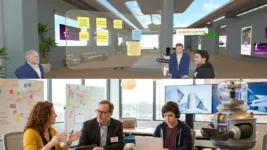
This brings us to the emerging world of Metaverse conferencing, with platforms like Arthur One Space leading the charge. They are pushing the boundaries of what is possible, yet they highlight exactly how far we still have to go. The picture above showcases this, it shows my meeting on Arthur compared to the resolution needed to make people feel like they are truly in another world (excuse the use of the Lost in Space Robot, I just thought that’d be fun).
From the World’s Fair to the Webcam: A History of Disconnect
The concept of video calling isn’t new; it’s older than the internet itself. The dream was formally introduced to the public at the 1964 New York World’s Fair where AT&T unveiled the Picturephone. It was a marvel of mid-century engineering, promising a Jetson-like future where distance would no longer matter.
However, the Picturephone was a commercial disaster. When it launched in the early 1970s, the service cost a staggering $160 a month (roughly $1,200 in today’s dollars) for a mere 30 minutes of call time. The equipment was bulky, the picture was grainy, and—crucially—nobody else had one. It was a network without a network effect.
For the next forty years, video conferencing remained the domain of high-end corporate boardrooms. Systems from Polycom and Cisco offered “Telepresence,” but they cost tens of thousands of dollars and required dedicated rooms. It wasn’t until the rise of Skype, and later FaceTime, that video calling became democratic. Yet, even as the technology became free and ubiquitous, it remained a secondary mode of communication—useful for grandmothers seeing grandchildren, but rarely the primary engine of business.
The Pandemic Stress Test and the Engagement Void
Then came 2020. Virtually overnight, the entire white-collar workforce was sent home. Platforms like Zoom, Microsoft Teams and Webex became our virtual offices. The technology worked—the bandwidth held up and business continued—but the psychological cracks appeared almost immediately.
“Zoom fatigue” became a recognized phenomenon. We learned that staring at a grid of faces, including our own, for eight hours a day is cognitively exhausting. More importantly, we discovered that video conferencing is excellent for transactions (sharing information) but terrible for interaction (building culture).
This failure is directly linked to the current tension over RTO mandates. CEOs are demanding workers return not necessarily because they hate remote work, but because they sense a degradation in company culture, loyalty and spontaneous innovation. Video calls eliminate the “water cooler” moments; they have no spatial reality. You are either “on” in a meeting or “off” alone in your house. There is no sense of sitting with your team.
Arthur Technologies: Walking the Line of Reality
This is the gap that Metaverse platforms like Arthur One are trying to bridge. Unlike the cartoonish, floating torsos of early Horizon Workrooms, Arthur is aiming for a professional, enterprise-grade realism. They have been one of the most aggressive innovators in trying to make Virtual Reality (VR) feel like a valid workspace rather than a video game.
Arthur Technologies was one of the first to tackle the “floating ghost” problem by introducing legs to avatars, grounding users in the virtual space. They realized early on that to be taken seriously in a boardroom, you cannot look like a Mii character. Arthur’s implementation allows for custom faces generated from a standard 2D photo. You upload a selfie, and the system wraps that texture onto a 3D head.
The platform also includes “Audio Zones,” a brilliant feature that mimics real life. In a standard Zoom call, only one person can speak at a time. In Arthur One, you can turn to the person next to you and have a private side conversation without interrupting the speaker, thanks to spatial audio. The tool also integrates Mixed Reality (MR) features, allowing you to bring your physical keyboard and desk into the VR environment, solving the “blindness” issue of wearing a headset.
The Uncanny Valley and Current Limitations
However, Arthur’s ambition also highlights the current limits of the technology. By pushing for photorealism, Arthur runs headfirst into the Uncanny Valley—that eerie dip in emotional response when a robot or avatar looks almost human but not quite.
While Arthur’s avatars are a massive step up from cartoons, they can still feel stiff. The eyes may not track perfectly, or the micro-expressions we rely on to judge intent (a slight furrow of the brow, a smirk) are missing or delayed. When you look at a cartoon avatar, your brain accepts it as an abstraction. When you look at a photorealistic avatar of your boss that doesn’t blink quite right, your primitive brain flags it as a “corpse” or “imposter.” It is unsettling.
Furthermore, the hardware remains a barrier. Even with lighter headsets like the Meta Quest 3 or the Apple Vision Pro, strapping a computer to your face for an hour-long meeting is physically taxing. The resolution, while improving, still makes reading fine text in a virtual spreadsheet more difficult than on a 4K monitor. Arthur has improved “pass-through” technology to help with this, but we are still limited by the physics of current optics and battery life.
The Road to 2030: What the Future Holds
For platforms like Arthur to truly replace the office, they must evolve past the “good enough” stage. By the end of this decade, we should expect a convergence of technologies that will finally fulfill the promise AT&T made in 1964.
- AI-Driven Micro-Expressions: Future avatars won’t just map your face; they will use AI to infer and render micro-expressions in real-time, perhaps using internal headset cameras (eye and face tracking) that are standard in all devices. This will kill the “dead eye” stare and bridge the uncanny valley.
- Holographic Form Factors: The headsets will likely slim down to the size of thick glasses, or we may move toward “Light Field” displays that project 3D images without the need for isolation from the real world.
- Haptics: We need to feel the handshake. While distant, simple haptic gloves or wristbands could provide the tactile feedback necessary to make a virtual agreement feel binding.
Wrapping Up
We are in the “brick phone” era of the Metaverse. Just as the Gordon Gekko-sized cell phones of the 1980s were laughable but necessary precursors to the iPhone, platforms like Arthur One are the necessary pioneers of immersive work. They are clunky and occasionally creepy, but they offer a glimpse of a future where geography truly doesn’t matter.
Until the technology creates an experience that is better and more comfortable than a physical meeting—rather than just a digital approximation of one—the pressure to return to the office will remain. But if companies like Arthur Technologies continue to iterate, the commute of 2030 might just be putting on a pair of glasses.